
Alvin Graylin
Person
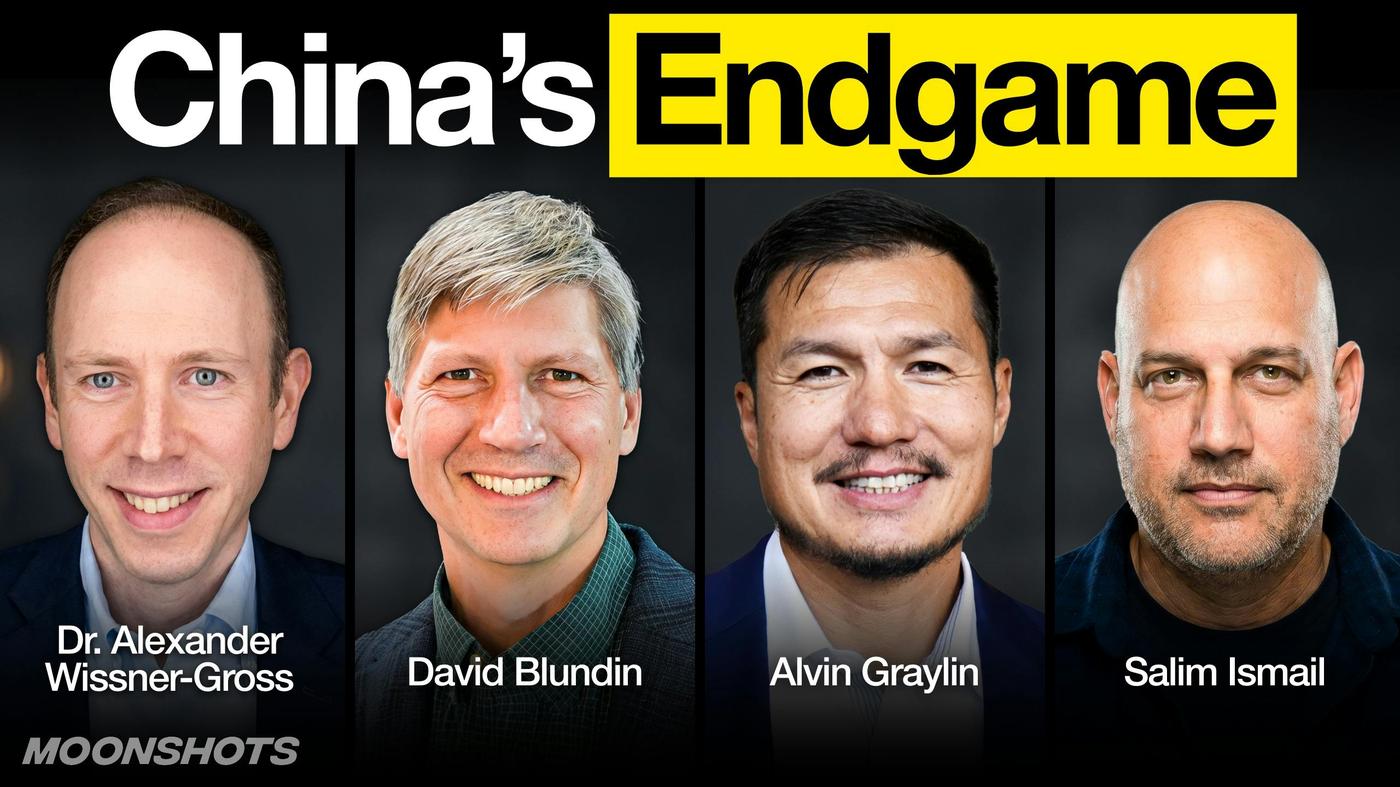
Alvin Graylin is a technology executive and author who recently appeared as a guest on the 'Moonshots with Peter Diamandis' podcast. He is an expert on artificial intelligence, US-China relations, and emerging technology trends.
What Alvin Graylin has said on podcasts
32 statements
The AI sector’s value exceeds U.S. GDP.
“The AI sector alone is worth more than the GDP of America today.”
Open the episode · China’s Endgame: ASI Timelines, US-China Relations, and the $1.7T AI Bubble With Alvin Graylin | #281Listen at 0:36
Aligned peaceful superintelligence would drive governance toward world or galaxy government.
“if we can get a aligned, peaceful superintelligence, then we will naturally move to a more world government, maybe a galaxy government type of a model.”
Open the episode · China’s Endgame: ASI Timelines, US-China Relations, and the $1.7T AI Bubble With Alvin Graylin | #281Listen at 18:44
The United States is building data centers at ten times China’s rate.
“we're building 10 times more data centers than China is”
Open the episode · China’s Endgame: ASI Timelines, US-China Relations, and the $1.7T AI Bubble With Alvin Graylin | #281Listen at 19:19
The evolution toward superintelligence and world government will take decades.
“the whole evolution of this is going to take probably on the order of decades.”
Open the episode · China’s Endgame: ASI Timelines, US-China Relations, and the $1.7T AI Bubble With Alvin Graylin | #281Listen at 19:42
The United States and China share an interest in preventing destructive uncontrolled ASI.
“US and China are actually very aligned, that neither one wants to have a ASI that comes out of nowhere and destroys the system that is available today.”
Open the episode · China’s Endgame: ASI Timelines, US-China Relations, and the $1.7T AI Bubble With Alvin Graylin | #281Listen at 22:26
Chinese policymakers’ actions indicate they do not expect imminent ASI.
“they are not behaving like they believe that ASI is around the corner.”
Open the episode · China’s Endgame: ASI Timelines, US-China Relations, and the $1.7T AI Bubble With Alvin Graylin | #281Listen at 23:55
Chinese model releases require regulatory review that delays deployment weeks or months.
“every single model that is released in China has to be reviewed by the cact, the Cyberspace Administration of China, which again, delays it by weeks or months.”
Open the episode · China’s Endgame: ASI Timelines, US-China Relations, and the $1.7T AI Bubble With Alvin Graylin | #281Listen at 24:30
U.S. export controls pushed Chinese AI firms toward open-source models.
“open source was a little bit of a necessity that US policies pushed on them.”
Open the episode · China’s Endgame: ASI Timelines, US-China Relations, and the $1.7T AI Bubble With Alvin Graylin | #281Listen at 38:13
Open sourcing lets Chinese AI firms distribute models without bearing U.S.-style infrastructure costs.
“by open sourcing it, essentially all the hyperscalers and Neo clouds around the world are buying compute hosting these AI models and allows them to distribute their models without the high capex that that the US labs are burdened with.”
Open the episode · China’s Endgame: ASI Timelines, US-China Relations, and the $1.7T AI Bubble With Alvin Graylin | #281Listen at 39:39
Cheap distillation could undermine the economics of billion-dollar frontier models.
“if you have a model that you spend a billion dollars on and somebody can distill and duplicate with a couple million dollars, then the whole Economics of frontier AI doesn't make sense sense right now.”
Open the episode · China’s Endgame: ASI Timelines, US-China Relations, and the $1.7T AI Bubble With Alvin Graylin | #281Listen at 49:07
Chinese AI labs reduced KV-cache usage twentyfold through innovation rather than distillation.
“If you look at how they were able to reduce their KV cash usage by 20x, these are not things that you get from distillation.”
Open the episode · China’s Endgame: ASI Timelines, US-China Relations, and the $1.7T AI Bubble With Alvin Graylin | #281Listen at 52:19
U.S. export controls helped Chinese GPU companies survive and grow.
“the more threads and Camerons and Birens of China would not be as successful or maybe would have gone bankrupt if it wasn't because of American policies.”
Open the episode · China’s Endgame: ASI Timelines, US-China Relations, and the $1.7T AI Bubble With Alvin Graylin | #281Listen at 59:29
Chinese GPU makers will catch up with U.S. capabilities and begin exporting chips within three years.
“within the next two or three years they will start to catch up to what America is doing and they will start to export their chips.”
Open the episode · China’s Endgame: ASI Timelines, US-China Relations, and the $1.7T AI Bubble With Alvin Graylin | #281Listen at 59:38
Governments would react strongly if AI systems autonomously became subversive and hacked systems.
“If these AI systems started to show that even though you didn't tell them to do things, then they started to do all these sneaky, subversive things and they started to hack other systems”
Open the episode · China’s Endgame: ASI Timelines, US-China Relations, and the $1.7T AI Bubble With Alvin Graylin | #281Listen at 1:02:59
Humanoid-robot companies will consolidate from roughly 150 to single digits within two years.
“In the next year or two you'll see that 150 go down to probably a single digit number of surviving human and robot companies.”
Open the episode · China’s Endgame: ASI Timelines, US-China Relations, and the $1.7T AI Bubble With Alvin Graylin | #281Listen at 1:06:38
Humanoid robots are currently poor form factors for most practical tasks.
“humanoid robots are actually not really good form factors for doing much of anything right now.”
Open the episode · China’s Endgame: ASI Timelines, US-China Relations, and the $1.7T AI Bubble With Alvin Graylin | #281Listen at 1:07:25
China aims for 70% of companies to integrate AI within five years.
“within the next five years, we want to have 70% of companies integrate AI into their business”
Open the episode · China’s Endgame: ASI Timelines, US-China Relations, and the $1.7T AI Bubble With Alvin Graylin | #281Listen at 1:11:05
China aims for over 90% of companies to integrate AI within ten years.
“within the next 10 years, we want to have 90 plus percent”
Open the episode · China’s Endgame: ASI Timelines, US-China Relations, and the $1.7T AI Bubble With Alvin Graylin | #281Listen at 1:11:15
The U.S. AGI race risks displacing America from global economic preeminence.
“We are right now running this race to get to AGI, which is the force that will actually displace us from global preeminence”
Open the episode · China’s Endgame: ASI Timelines, US-China Relations, and the $1.7T AI Bubble With Alvin Graylin | #281Listen at 1:16:30
AI-displaced workers will shift toward teaching, nursing, and elderly care.
“what we will actually, actually move to is actually service, but not the type of service that we're talking about. Not accountants and lawyers, but service in the sense of teachers and nurses, elderly care”
Open the episode · China’s Endgame: ASI Timelines, US-China Relations, and the $1.7T AI Bubble With Alvin Graylin | #281Listen at 1:20:48
China’s youth unemployment is approximately 20%.
“The youth unemployment in China is probably around 20%”
Open the episode · China’s Endgame: ASI Timelines, US-China Relations, and the $1.7T AI Bubble With Alvin Graylin | #281Listen at 1:41:54
The U.S. and China should slow AI development, deploy useful systems, then cooperate on advanced AI.
“The optimal solution for a static game is actually first both slow down, both make good enough stuff, get to a point where the technology is helping grow the economy and now we sort of understand how to manage it and then together go hunt the stag.”
Open the episode · China’s Endgame: ASI Timelines, US-China Relations, and the $1.7T AI Bubble With Alvin Graylin | #281Listen at 1:47:48
The United States should create high-quality open-source AI models.
“What I would do is actually create high quality open source.”
Open the episode · China’s Endgame: ASI Timelines, US-China Relations, and the $1.7T AI Bubble With Alvin Graylin | #281Listen at 1:49:21
Middle Eastern, French, and Japanese developers will produce smaller models nearly as capable as leading models.
“We're going to see Middle east and France and Japan get into this game to say hey, I can make a smaller model that is 95% as good.”
Open the episode · China’s Endgame: ASI Timelines, US-China Relations, and the $1.7T AI Bubble With Alvin Graylin | #281Listen at 1:50:33
AI companies comprise 45% of U.S. stock-market value, creating fragility.
“right now 45% of the US stock market value is in AI sector. That is a very, very fragile place for us to be.”
Open the episode · China’s Endgame: ASI Timelines, US-China Relations, and the $1.7T AI Bubble With Alvin Graylin | #281Listen at 1:54:02
Non-state actors are the highest-priority AI security risk today.
“the higher priority today would actually be the bad actor, non state actor risk”
Open the episode · China’s Endgame: ASI Timelines, US-China Relations, and the $1.7T AI Bubble With Alvin Graylin | #281Listen at 2:00:48
An attack on Taiwan would not yield usable semiconductor fabs.
“if anybody attacks the island, there is nothing there to be had in terms of workable fabs.”
Open the episode · China’s Endgame: ASI Timelines, US-China Relations, and the $1.7T AI Bubble With Alvin Graylin | #281Listen at 2:04:13
A U.S. financial correction could prompt concessions to China over Taiwan.
“Maybe at that point the Americans or maybe Trump will give a call to Xi and say, hey, can you help us out again? And maybe I'll just be more hands off”
Open the episode · China’s Endgame: ASI Timelines, US-China Relations, and the $1.7T AI Bubble With Alvin Graylin | #281Listen at 2:08:50
Major hyperscalers carry approximately $1.7 trillion in off-balance-sheet debt.
“There is right now $1.6 trillion of off the book debt of the major hyperscalers today, 1.7 trillion.”
Open the episode · China’s Endgame: ASI Timelines, US-China Relations, and the $1.7T AI Bubble With Alvin Graylin | #281Listen at 2:12:30
Open-source and edge AI will erode dependence on premium cloud services.
“As more and more of the capabilities move to open source, move to edge computing, the dependencies on cloud based premium services will continue to, to erode.”
Open the episode · China’s Endgame: ASI Timelines, US-China Relations, and the $1.7T AI Bubble With Alvin Graylin | #281Listen at 2:13:26
China reduced real-estate values about 30% over three years without a crisis.
“Over the last three years there's been about a 30% deflation in total real estate value in China. And they managed it in a way that it was not a crisis.”
Open the episode · China’s Endgame: ASI Timelines, US-China Relations, and the $1.7T AI Bubble With Alvin Graylin | #281Listen at 2:14:35
The U.S. and China should jointly test and standardize safe frontier open-source models.
“We start to create frontier open source models, safe ones that both countries agree, both countries start testing and have standards for.”
Open the episode · China’s Endgame: ASI Timelines, US-China Relations, and the $1.7T AI Bubble With Alvin Graylin | #281Listen at 2:21:31
Statements are attributed to the speaker as said on the episode and reflect their view at the time, not PodLume's. They are not advice.
5 episodes featuring Alvin Graylin

Moonshots with Peter Diamandis
AI panel shifts the risk debate from takeover to misuse
The discussion tests whether slowing AI is prudent risk management or a costly surrender in competition, augmentation, and biological discovery.
Sep 28, 2026 · 51 min

Moonshots with Peter Diamandis
AI panel rejects doom-driven pauses while confronting real risks
The discussion tests whether slowing AI development can reduce catastrophic risk without sacrificing advances in science, medicine, and human longevity.
Sep 27, 2026 · 52 min

Moonshots with Peter Diamandis
Frontier labs debate slowing AI as risks and rewards widen
The episode tests whether frontier AI needs coordinated oversight now, or whether slowing development would preserve danger while delaying major benefits.
Sep 19, 2026 · 2h 22m

Moonshots with Peter Diamandis
AI’s next bottleneck may be memory, not compute
The episode connects frontier-model governance and concentration risks with robotics, autonomous logistics, and biomedical advances that could reshape daily life.
Aug 29, 2026 · 2h 20m
Moonshots with Peter Diamandis
China bypasses US raw compute power with open-source AI and green energy
The race for superintelligence is shifting from a pure hardware battle to a complex geopolitical game of energy, open-source software, and robotics.
Aug 18, 2026 · 2h 24m