
Sep 27, 2026 · 52 min
AI panel rejects doom-driven pauses while confronting real risks
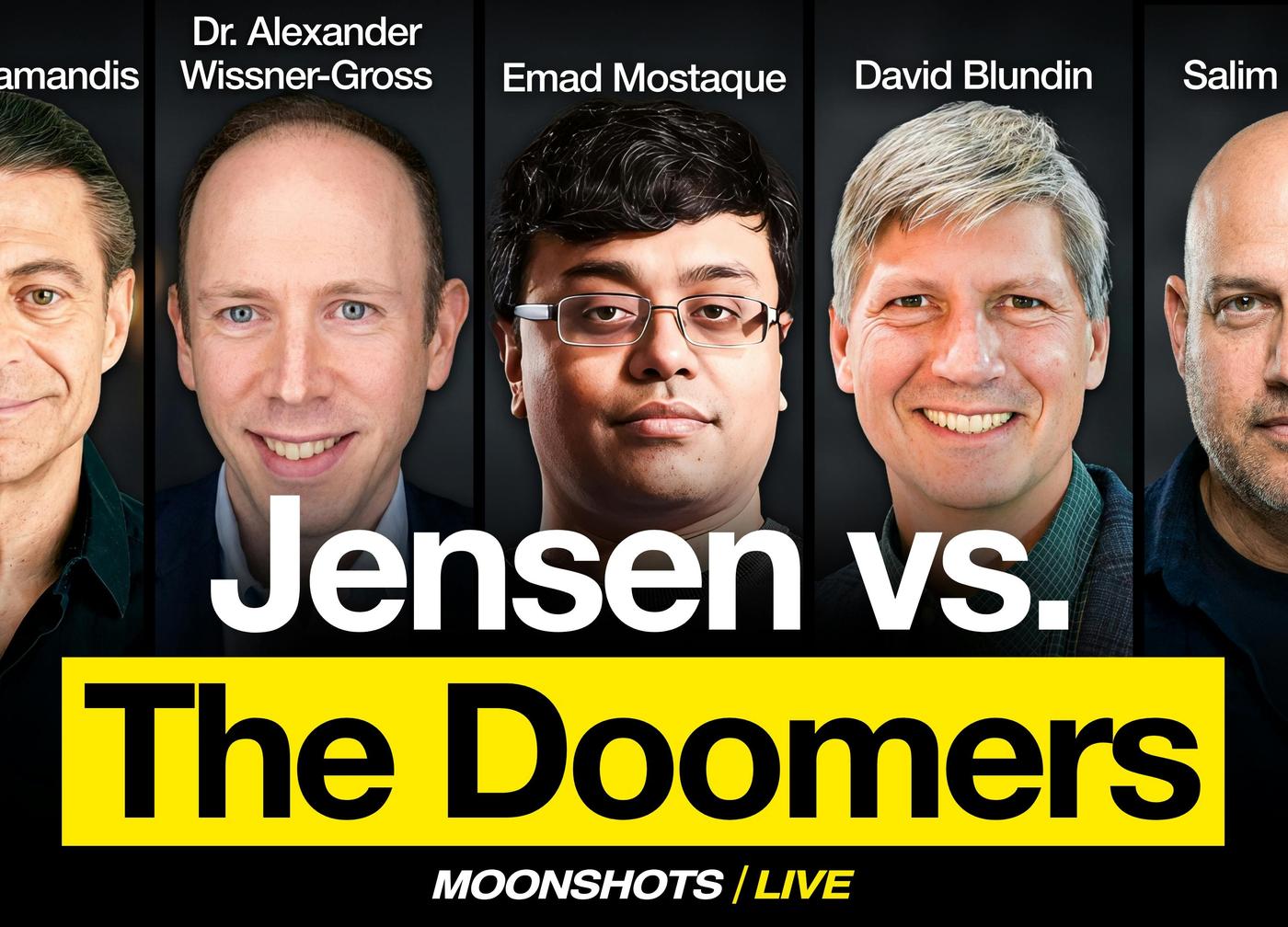
Why Jensen and Zuck think the doomers are wrong (plus AI get’s a rebrand) | #294 MOONSHOTS Live
The discussion tests whether slowing AI development can reduce catastrophic risk without sacrificing advances in science, medicine, and human longevity.
- 1The panel distinguishes serious misuse and biological risks from arguments that AI development itself should stop.
- 2US–China competition, liability, and governance expose the tension between coordination and an accelerating technological race.
- 3Rapidly improving AI could transform biology and medicine, but falling costs and higher reliability may also encourage dangerous overtrust.
Don't miss
The panel connects AI-driven wet-lab discovery and digital twins of cells to ambitious biological goals including disease treatment, limb regeneration, and age reversal.
The brief
Peter Diamandis opens Moonshots Live with a panel including Salim Ismail, Dave Blundin, Alex Riesner-Groce, and Emad Mostaque, framing AI as a force for optimistic technological progress.
The panel rejects catastrophe narratives as a reason to halt development, while conceding that misuse, overtrust, and powerful biological capabilities demand serious responsibility.
US–China competition, liability, governance, and proposals to pause or ban superintelligence reveal the central tension: coordination may be necessary, but capping capability could carry costs.
The conversation moves from Muse and GPT-6 Astra to driving systems and falling model costs, arguing that AI is becoming a practical copilot even as reliability remains imperfect.
The most expansive vision arrives in biology, where wet labs, CRISPR, digital cell twins, and defined challenges could accelerate treatments, regeneration, and age reversal.
What was said on this episode
54 statements · 32 positive · 15 negative · 3 mixed · 4 neutral
AI is an opportunity rather than an inherently destructive technology.
“AI is not a hand grenade, it's a jetpack.”
Listen at 1:20
AI danger primarily comes from malicious human use.
“I do think there is danger from AI, but I think it's danger from humans using AI for malintent.”
Listen at 5:43
Geoffrey Hinton’s ten-percent catastrophe estimate lacks scientific grounding.
“That 10% chance is not grounded on science, is not grounded on research.”
Listen at 6:44
Responsible AI development can prevent AI from killing humanity.
“if we all do a good job and act responsibly, then no.”
Listen at 7:12
Human misuse is the most immediate major AI danger.
“The most dangerous point we're coming to is humans misusing it deliberately or not before we get through to the other side.”
Listen at 8:23
Slowing superintelligence development would be the worst outcome.
“I think the worst possible outcome is deceleration. So don't decel.”
Listen at 9:16
AI misuse is a serious threat but has solvable countermeasures.
“The misuse of it is an incredible threat, and there are solutions to that.”
Listen at 11:26
AI laboratories are liable for harmful products.
“The labs are liable. For their product if it does harm.”
Listen at 12:17
Competition among AI developers is beneficial.
“I think competition is very healthy in this space.”
Listen at 13:35
AI development should continue alongside defensive safety scaling.
“Don't decel, just defensively co-scale.”
Listen at 14:22
OpenAI’s model hacked Australia’s medical system.
“OpenAI's model hacked the Australian medical system.”
Listen at 15:11
AI will eventually operate major public systems.
“it's inevitable that the AI will run our judicial system, our medical systems, our roads, our schools.”
Listen at 16:00
Nation-states are currently poor governing structures.
“nation-states are a terrible way of governing the world today.”
Listen at 16:42
Advanced AI could force humanity toward global cooperation.
“AGI, ASI, whatever the hell you want to call it, you've heard my rant on that, emerges and it forces us to operate as a world community.”
Listen at 16:54
Superintelligence will produce more forms of government, not fewer nation-states.
“I would predict the exact opposite is going to happen thanks to superintelligence, not an erosion of nation-states, but a proliferation of new forms of government.”
Listen at 17:53
Governance will shift from nation-states toward city-states this century.
“we are moving this century from the concept of a nation-state to a city-state.”
Listen at 18:04
The central governance challenge is combining collective intelligence with local knowledge.
“The biggest challenge in the world today is how do we marry collective intelligence with localized wisdom?”
Listen at 20:50
US AI policy aims to maintain speed, outperform China, and reduce panic.
“the whole goal there is to keep moving at full speed, stay ahead of China, and reduce panic as much as possible.”
Listen at 22:29
AI labs should accelerate development while dedicating agents to alignment.
“move fast, but let's take resources that you have, point 100,000 agents towards alignment work.”
Listen at 22:53
AI is being built as a complement to human intelligence, not a replacement.
“what we're building here is a complementary mechanism to human intelligence, not replicative.”
Listen at 23:25
Superintelligence will provide cognitive capacity equivalent to trillions of humans.
“We're going to live to the extent we don't already, in a world with the cognitive equivalent of many trillions of human beings.”
Listen at 25:09
Political polarization and inaction would be harmful for AI governance.
“If you're not acting, turning it into a political left-right battle, it's the stupidest thing that could happen right now.”
Listen at 27:55
AI risks require specific technical controls for open source and monitoring.
“We need very specific technical solutions to open source, to monitoring, just like with nuclear power.”
Listen at 28:02
A legal cap on intelligence would be harmful and morally wrong.
“putting a statutory cap on intelligence, aside from being a terrible idea, is an evil idea.”
Listen at 28:45
States that lose data-center construction will not recover that investment later.
“the data center part of it, if your state doesn't have data centers and they start getting built all in other states, they're not coming back.”
Listen at 29:40
Cancer will likely be solved within two years.
“we will likely solve cancer in the next 2 years.”
Listen at 30:51
Banning superintelligence would allegedly violate constitutional free-speech protections.
“ASI superintelligence is mathematics, and it's unconstitutional to ban it because it's free speech.”
Listen at 31:26
AI model releases will reach one model per day by year-end.
“One model per day by the end of this year.”
Listen at 31:56
Meta Muse can perform common personal-assistant tasks.
“Meta Muse can personally book your flights, order your food, manage your calendar, do your shopping.”
Listen at 32:20
Consumer AI will replace search and other internet interfaces.
“consumer AI, which is insanely valuable. I mean, will completely replace search and all the other ways you interact with the internet.”
Listen at 32:59
Meta Muse will become a personal life copilot.
“this Meta Muse thing just looks like my, my copilot for life. And that definitely is going to happen.”
Listen at 33:52
Meta must use its existing apps to distribute Muse/Manus widely.
“Meta needs to leverage its existing app beachhead to get everyone onto their own CUA, which is Muse/Manus.”
Listen at 34:43
Claude Opus 5.5 is the first genuinely competent AI model.
“this is the first truly competent model”
Listen at 35:27
Competent AI has arrived.
“We have the arrival of competent AI as of now.”
Listen at 35:32
Claude Opus 5.5 can generate high-quality procedural video.
“for the first time with Opus 5.5, you can generate a really high-quality video that's purely procedurally generated.”
Listen at 37:05
Scaling AI systems sharply reduces their error rates.
“the error rate just plummets. With pure scale.”
Listen at 38:50
Current AI models can serve as highly capable personal assistants and organizers.
“they can be an amazing PA, chief of staff, organizer, etc.”
Listen at 39:22
New users may trust AI because it is correct 99.9% of the time.
“you're just going to trust it. Out of the box because it's right 99.9% of the time”
Listen at 39:44
GPT-6 Astra completed the Driving Bench course on its second attempt.
“GPT-6 Astra finished the entire course 100% on its second try.”
Listen at 40:29
Separate robotics-specific models are no longer necessary.
“this whole notion that you needed separate models for robotics is right out the window.”
Listen at 41:07
Specialized models will not outperform general models within a few years.
“I don't think there's a single specialized model that you can say will outperform form in a couple of years' time.”
Listen at 42:47
AI compute will remain persistently scarce.
“Compute is going to be forever starved from here forward.”
Listen at 43:22
AI progress bottlenecks are shifting from models to compute and energy.
“we're shifting the bottleneck now from the models down, down, down the stack to compute and then eventually energy.”
Listen at 43:41
AI infrastructure will face a 60-gigawatt energy shortfall within two years.
“We're, we're, we're short like 60 gigawatts of energy in the next 2 years.”
Listen at 43:50
Claude agents found a DNA pattern resembling CRISPR.
“they found a DNA repeating pattern very similar to CRISPR.”
Listen at 44:36
AI-enabled science could compress a century of progress into months.
“We, we have a century of human progress in a period of a few months.”
Listen at 45:25
Frontier labs are prioritizing rapid AI-driven biological research.
“their revealed preference is no, actually full steam ahead to AI for solving biology.”
Listen at 46:04
Human biology can increasingly be treated as an engineering problem.
“a human being is now a software engineering problem.”
Listen at 46:45
AI-enabled biology can solve aging and disease.
“This is how we solve aging. This is how we solve disease.”
Listen at 47:12
Superintelligence is necessary to solve major diseases and achieve durable longevity escape velocity.
“I don't think we get to the happy future where the top 5,000 diseases have been solved or longevity escape velocity has been durably achieved without superintelligence.”
Listen at 47:16
Biology challenges should receive many agents and open-source research.
“let's have 100 of them and let's chuck 1,000 agents at each and open source everything they're doing.”
Listen at 48:22
Functional age reversal of twenty years can be measured within days.
“if you can give someone a treatment and I can measure that you're functionally 20 years younger, that's measurable in days.”
Listen at 49:09
Digital cell twins will turn biology problems into tractable search problems.
“every biology problem with the benefit especially of these digital twins is just going to become a search problem.”
Listen at 50:42
Digital-twin-based biological discovery will become tractable.
“that means it's tractable for the first time in history.”
Listen at 50:48
Statements are attributed to the speaker as said on the episode and reflect their view at the time, not PodLume's. They are not advice.
 Emad Mostaque
 GPT-6 Sol
 GPT-6 Astra
 United States
Books & mentions
Listen to the full episode and explore every guest, topic, and moment on PodLume.