
Aug 12, 2026 · 1h 4m
Startups deploy hardware automation to slash shipping costs and expand healthcare
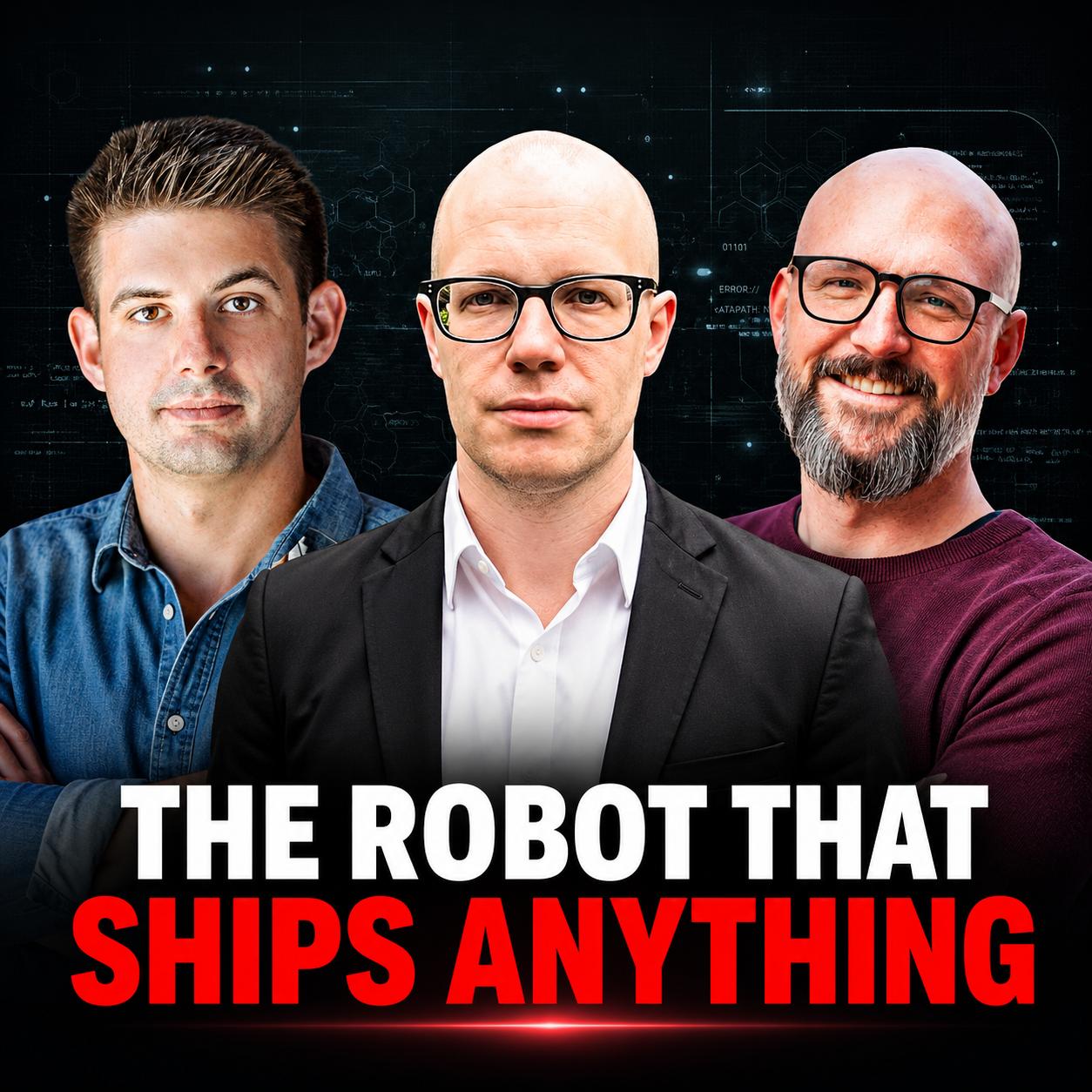
These robots could cut delivery costs by 80% | Next Unicorns
Automation is moving beyond software as physical robotics and specialized kiosks begin to restructure the economics of local retail logistics and basic healthcare delivery.
- 1Cytronic uses modular, robotic micro-fulfillment centers near urban hubs to reduce e-commerce shipping costs by up to 80 percent.
- 2IBOT deploys high-tech kiosks to automate vision testing, helping to address a critical global shortage of eye care professionals.
- 3Both startups leverage recent venture capital funding to scale hardware manufacturing and expand physical footprints in major US cities.
Don't miss
Kevin Gibbon details the unit economics of Cytronic's micro-fulfillment centers and how they achieve an 80% cost reduction.
The brief
The post-pandemic e-commerce landscape demands unprecedented speed and efficiency. While retail giants dominate automated logistics, smaller direct-to-consumer brands struggle to keep pace with rising shipping costs and complex distribution networks.
Cytronic founder Kevin Gibbon is leveling the playing field. By deploying modular, robotics-first micro-fulfillment centers closer to urban centers like Dallas and Chicago, his startup aims to slash shipping and logistics costs for mid-sized brands by up to 80%.
Meanwhile, healthcare is facing its own automation revolution. Matthias Hofmann of IBOT is deploying high-tech testing kiosks to address a global doctor shortage, offering rapid, low-cost vision tests to help the 1.5 billion people who lack access to glasses.
From automated warehouses to robotic eye exams, physical automation is moving out of industrial parks and into local communities. These startups prove that specialized hardware can drastically lower consumer costs while expanding access to vital services.
What was said on this episode
30 statements · 18 positive · 10 negative · 1 mixed · 1 neutral
Shipping logistics’ main pain points are cost and, especially for ecommerce, speed.
“shipping and logistics is a huge, huge category. But. But like across the board, what is the biggest pain point? And really it's cost. And then with especially the E commerce, it's speed.”
Listen at 2:44
Combining multiple robotic point solutions as a managed service can become transformative.
“if you put together enough of them and then manage them as a service, it can become one”
Listen at 4:52
Cytronic can reduce robotic order-picking costs to cents per order.
“We're able to take it down to cents with doing the actual robotics.”
Listen at 7:07
Warehouse receiving remains the largest human-labor need in fulfillment.
“the receiving process that today is probably the biggest need still for human labor”
Listen at 7:50
Amazon’s Kiva Robotics system is about 20 years old and not ideal for ecommerce picking.
“They're using a 20 year old system. Like Kiva Robotics is not the ideal for e commerce picking.”
Listen at 9:22
Amazon’s warehouse approach is inefficient and requires thousands of robots.
“it's really, it's inefficient. That's what it is. And they need thousands of these robots.”
Listen at 9:55
Cytronic charges roughly $0.70 for a two-item order while maintaining strong gross margins.
“we charge you, it's 50 cents per order, 10 cents per pick. So that same order would be 70 cents. And we still make like really good money on that. On gross margins because it's mostly robots.”
Listen at 12:05
A Cytronic facility becomes meaningfully profitable around 10,000 orders daily and can handle 30,000.
“it's about 10,000 orders per day to. When we start getting into some real profits, we can, we've, we've tested it out. We could do about 30,000 orders a day.”
Listen at 12:45
Cytronic requires approximately $1.2 million of upfront capital expenditure per warehouse.
“1.2, $1.2 million in upfront capex per warehouse.”
Listen at 13:44
Traditional fulfillment becomes more expensive per unit as it scales.
“fulfillment is like one of the only things that as you scale it actually gets more expensive on a per unit cost.”
Listen at 17:09
Cytronic intends to pass delivery-cost savings to customers.
“Wherever we can trim costs and pass those savings to our customers, we're going to”
Listen at 19:20
Shipping costs more than fulfillment in ecommerce transactions.
“Shipping is actually more expensive than fulfillment.”
Listen at 19:32
A service layer will emerge above robotics point solutions in logistics.
“there is going to be a service layer on top of a lot of these different point solutions”
Listen at 28:42
Individual robotics point solutions will mostly become commoditized.
“I just believe that it's going to mostly get commoditized”
Listen at 29:07
IBOT tests vision in 90 seconds and enables a teledoctor to issue prescriptions within minutes.
“The whole thing only takes about 90 seconds. And then within that time, you know, you punch in your. After you do the test, you punch in your name, information, email, and then it goes. All that information that gets packaged, goes to the cloud and gets paired with one of our teledoctors, who then review that session and then write a script to your eyes. So you can essentially get an eyeglass prescription within minutes.”
Listen at 32:06
Comprehensive eye exams can diagnose diabetes.
“you can diagnose diabetes actually through a comprehensive eye exam”
Listen at 34:37
IBOT targets users who need prescriptions rather than comprehensive eye-health examinations.
“all you need is a pair of new glasses or contact lenses, which for that you only need an eyeglass prescription. And that's really where IBOT today comes in.”
Listen at 35:43
An IBOT prescription costs between zero and $25.
“So it's anywhere between 0 to $25.”
Listen at 37:18
IBOT can equalize vision-prescription access regardless of insurance status.
“IBOT is here to really level the playing field.”
Listen at 39:37
IBOT uses ophthalmologists and optometrists licensed in the states where they prescribe.
“we have our ophthalmologists and we have our optometrists and yeah, they get queued in depending on which state it is and obviously they're all licensed in the state that they work in and prescribe in”
Listen at 40:45
Children are 80% more myopic than they were 20 years ago.
“our kids are 80% more myopic than they were 20 years ago”
Listen at 43:34
The United States may have 20–30% fewer ophthalmologists within ten years.
“The ophthalmology is projected to have 20 to 30% fewer ophthalmologists in 10 years.”
Listen at 44:22
Automating healthcare is necessary to meet current and future demand.
“the only way to meet the demand of today and even into the future is that we need to automate healthcare”
Listen at 45:05
IBOT incorporates advanced autorefraction and visual-acuity technologies.
“we have a very advanced auto refraction technology. We have a very advanced visual acuity system”
Listen at 46:09
IBOT prescriptions have substantially lower remake rates than the industry average.
“we also have extremely low remake rates. Remake rate is, you know, how often do people go back and say, hey, I want this prescription changed. I don't like it. Yeah, we beat the industry average by a considerable amount.”
Listen at 53:10
About 1.5 billion people currently have impaired vision correctable with glasses.
“1.5 billion humans on this planet right now are not seeing well. And all they need is a pair of glasses.”
Listen at 54:54
Most general-purpose eyeglasses cost less than $20 to manufacture.
“in general, most pairs of eyeglasses cost less than 20 bucks to make. All in.”
Listen at 56:05
Eyeglasses should be commoditized, but prescription access remains a bottleneck that automation will address.
“This should be unbelievably commoditized. Yes. And it's not. And the big bottleneck, that's where we're stuck as a humanity is, as a species is like getting to the numbers to getting those, those glasses. And that is the next piece that is getting automated.”
Listen at 56:43
Doctors should remain involved because writing high-quality eyeglass prescriptions requires science and experience.
“doctors need to be in the loop. And as it turns out that in our case, writing great eyeglass prescriptions is. Not many people know this, but it is science and also art.”
Listen at 57:47
IBOT doctors review every vision-testing session like a clinic encounter.
“we're going to have, you know, doctors. We have doctors review every session and deal with every session the same way it happens in a clinic.”
Listen at 59:19
Statements are attributed to the speaker as said on the episode and reflect their view at the time, not PodLume's. They are not advice.
Featuring
Mentioned
 Cytronic
 iBOT
iBOT Vision Testing
 Boston
Books & mentions
This Week in Startups
To explore more interviews with founders building cutting-edge hardware and logistics solutions
Listen to the full episode and explore every guest, topic, and moment on PodLume.