
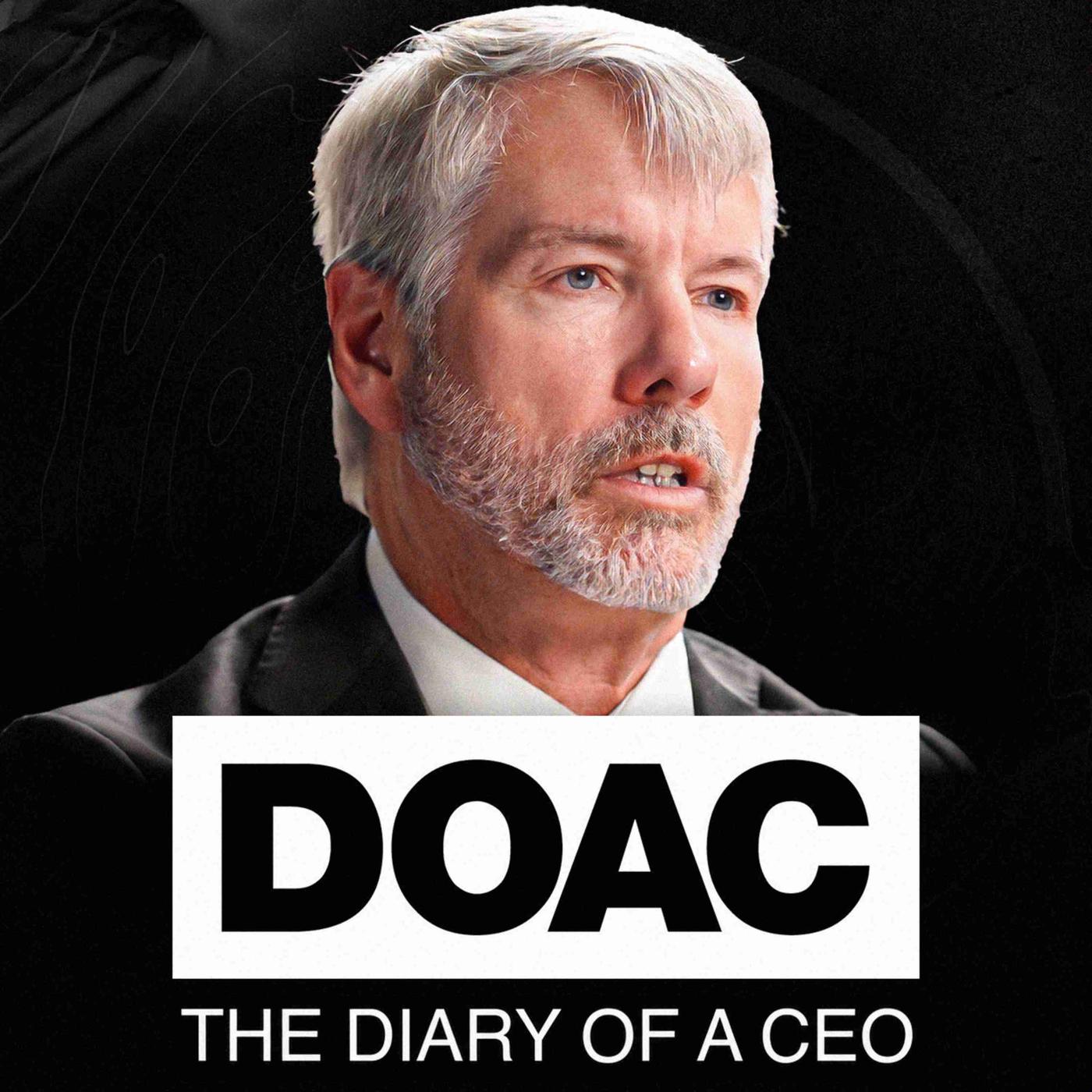
Aug 6, 2026 · 1h 40m
Michael Saylor explains how he used AI to secure fifteen billion dollars
Top Bitcoin Holder: Ask AI To Do THIS, Stop Trying To Out-Work The Robots! | Michael Saylor
As artificial intelligence and automation disrupt traditional career paths and economic structures, understanding how to leverage digital intelligence and secure scarce assets is critical for long-term wealth preservation.
- 1Traditional physical assets and cash face severe inflation and counterparty risks that digital capital can bypass entirely.
Don't miss
Saylor explains how he used ChatGPT to structure a complex preferred stock security to raise billions.
The brief
MicroStrategy co-founder Michael Saylor joins Steven Bartlett to outline a paradigm shift where traditional assets like real estate and cash are rapidly losing ground to digital capital and artificial intelligence.
Saylor argues that physical cash and centralized banks harbor massive counterparty risk, while inflation quietly erodes purchasing power, making decentralized digital assets the only reliable long-term store of value.
In a striking revelation, Saylor details how he used ChatGPT to design a novel preferred stock security, enabling MicroStrategy to raise fifteen billion dollars to acquire more Bitcoin.
As artificial intelligence and robotics accelerate, Saylor warns that traditional career paths in law, accounting, and surgery face severe disruption, urging young professionals to study digital intelligence.
The ultimate competitive advantage in an AI-saturated world will belong to those who secure scarce digital assets and leverage AI tools to multiply their cognitive output.
What was said on this episode
50 statements · 35 positive · 10 negative · 5 neutral
Entrepreneurs should ask AI to create novel solutions rather than outwork robots.
“What you want to do is ask the AI to do something that's never been done before.”
Listen at 0:12
Bitcoin will be the best long-term capital asset.
“it's going to be the best long term capital asset”
Listen at 0:36
Bitcoin can transfer one million dollars globally within seconds.
“I could move a million dollars of bitcoin from here to anywhere, to London to anywhere in cyberspace in a few seconds.”
Listen at 1:02
Bitcoin has recently appreciated faster annually than gold.
“Gold is up 12% a year, but Bitcoin is up 33.”
Listen at 1:16
Bitcoin will outperform the S&P 500 by approximately two times.
“You're going to get double the performance from BTC that you would get from like the S and P index.”
Listen at 1:21
Bitcoin private keys can protect monetary ownership from more powerful parties.
“you basically encrypt the money, put it in cyberspace, protect it with a private key.”
Listen at 4:27
The US dollar lost approximately 7% of its economic value annually over a century.
“the US dollar lost 7% of its value every year going for 100 years.”
Listen at 8:59
The average fiat currency collapses after roughly 29 years.
“The average fiat currency collapses in about 29 years, I think.”
Listen at 9:49
Wealth preservation requires acquiring scarce, desirable property.
“if you're trying to preserve your wealth, you have to acquire scarce desirable property.”
Listen at 10:29
Florida houses face approximately 2% annual property taxes.
“there's a 2% property tax on houses in Florida”
Listen at 10:49
Commercial real estate can appreciate approximately 7% annually after rent offsets expenses.
“the underlying million dollars appreciates 7% a year, every year.”
Listen at 11:43
Commercial real estate is generally a better wealth-building strategy than residential property.
“a better idea generally is commercial real estate.”
Listen at 12:47
Bitcoin is presented as an asset capable of appreciating 15% annually.
“an asset which appreciates in value 15% a year”
Listen at 13:51
Investors seeking conventional wealth preservation should buy an S&P 500 index fund.
“I just buy the S and P index.”
Listen at 15:03
Investors should avoid assets that factories, robots, or AI can produce abundantly.
“Don't invest in things that a factory or a robot or an AI can generate.”
Listen at 16:25
Investors should favor scarce assets that automation cannot mass-produce.
“buy things that the robots and the AIs and the big factories cannot pump out by the million gallons.”
Listen at 16:32
Autonomous vehicles will drive themselves.
“Cars are going to drive themselves.”
Listen at 18:10
Robots will eventually perform essentially unlimited amounts of work.
“the robots will do any amount of work.”
Listen at 21:06
AI and robotics will make utilitarian consumer goods abundant.
“consumer goods, consumables, utilitarian goods will become abundant.”
Listen at 22:37
Scarce desirable luxury goods will remain limited despite technological abundance.
“there are always going to be scarce, desirable goods that will not become abundant.”
Listen at 22:43
Money will remain relevant despite cheaper basic goods and services.
“money's not going away.”
Listen at 26:24
AI-driven labor disruption will produce political unrest.
“There'll be dislocation, there's going to be political unrest.”
Listen at 27:36
Freer societies will generate thousands of new businesses and employment opportunities after technological disruption.
“in a more free society, you're going to have 10,000 new kinds of businesses pop up or 100,000 new business opportunities”
Listen at 29:01
Saylor says AI helped create $15 billion through an unprecedented financing approach.
“I used an AI to make $15 billion in a way that no one would ever conceive”
Listen at 33:10
MicroStrategy needed a novel security to finance additional Bitcoin purchases.
“we needed to invent a new type of security, a new type of credit instrument”
Listen at 33:58
ChatGPT can help design a variable-dividend preferred stock.
“can we do it? Like, of course you can do it.”
Listen at 36:50
Entrepreneurs should learn and use one or more AI tools.
“you definitely should pick one or more of these AIs”
Listen at 38:14
Effective AI entrepreneurship still requires domain expertise.
“you do need to have some domain expertise in something”
Listen at 38:34
Students risk poor career choices by entering fields at the end of their growth curve.
“The mistake to make when you go to school is you get at the end of the S curve”
Listen at 40:58
AI-connected smart glasses can eventually perceive users’ visual and auditory environments.
“can I create smart glasses where I have something that's like my Maui Jim sunglasses? I put them on, they weigh nothing, and they have the camera and they see what I see and they hear what I hear”
Listen at 42:56
Students should avoid specializing in tasks AI can already perform.
“you don't want to learn how to do things that AI can do.”
Listen at 45:48
Creating value requires introducing something previously absent.
“The way you create value in the world is you bring something into the world that wasn't here before.”
Listen at 46:30
Content creators should study digital distribution channels.
“my advice would be study digital channels.”
Listen at 48:36
The strongest content moat will be highly talented, broadly desired content.
“The moat's going to be the most talented content, the person creating the best stuff that everybody wants to see.”
Listen at 50:38
New technology opportunities typically have a 12-to-24-month window for breakout success.
“that window is like 12 to 24 months.”
Listen at 54:20
Entrepreneurs usually need at least four years to achieve success.
“If you're successful in less than four years, you got lucky.”
Listen at 1:03:10
A 12-month technological lead can create a lasting competitive advantage.
“you're 12 months ahead of everybody”
Listen at 1:05:34
Businesses should become exceptional in one focused area rather than mediocre broadly.
“You want to be exceptional in one area”
Listen at 1:07:32
Dilutive distractions and expansions cause many businesses to fail.
“The phenomenon that causes most businesses to fail, it's dilutive distractions or where it's dilutive expansions.”
Listen at 1:09:39
Building adjacent offerings on existing strengths produces more stable growth.
“if you're thinking your growth strategy is to build on a foundation of something you already had and extend its functionality in a natural fashion, that's natural, stable growth.”
Listen at 1:14:09
People’s character and outcomes are influenced by the people surrounding them.
“you become who you surround yourself with.”
Listen at 1:19:19
MicroStrategy would remain overcollateralized if Bitcoin fell to $5,000.
“if bitcoin could fall to $5,000 a coin, we would still be over collateralized against the debt.”
Listen at 1:24:19
Bitcoin is the best long-term investment among listed capital assets.
“I think that bitcoin is the best”
Listen at 1:25:48
MicroStrategy should sell Bitcoin if its stock trades below the value of its Bitcoin assets.
“if the common stock ever sells at a discount or trades at a discount to the bitcoin assets, then you sell bitcoin in order to protect the common stock.”
Listen at 1:30:35
Bitcoin will appreciate 30% annually for 20 years, then approximately 20% annually.
“I think it appreciates about 30% a year for the next 20 years. Right. And then it'll slow down to being appreciated about 20% a year.”
Listen at 1:30:50
Bitcoin will outperform the S&P 500 by 1.5 to 2 times.
“I think it outperforms the S and P index by a factor of, of 1.5 to 2.”
Listen at 1:31:07
People needing their money within 12 weeks should not buy Bitcoin.
“The people that shouldn't buy it are people that need the money back in 12 weeks.”
Listen at 1:31:52
People should pay for a premium AI subscription before investing surplus capital.
“you should definitely spend money necessary to get the Super Grock or the Pro, the Professional Edition”
Listen at 1:32:43
People should read Taleb’s books and study applied statistics.
“anybody that hasn't read all of those books probably ought to go read those books and obsess over applied statistics.”
Listen at 1:34:50
Every historical currency has experienced debasement.
“every currency, everywhere in history has been debased.”
Listen at 1:36:56
Statements are attributed to the speaker as said on the episode and reflect their view at the time, not PodLume's. They are not advice.
What people are saying
Saylor says ChatGPT helped create $15 billion—then explains why AI changes work and money
Episode reactions
- Saylor’s claim that ChatGPT helped create $15 billion in credit became the episode’s standout talking point.
- Listeners praised Saylor’s conviction and his discussion of AI, money and Bitcoin, calling the interview eye-opening and a masterclass.
- Critics seized on the apparent contradiction between “never sell Bitcoin” and Strategy’s reported sales, questioning his explanation to Bartlett.
Wider topic conversation
- Discussion extended to whether AI will replace routine professional jobs and whether people should learn what machines cannot do.
- Saylor’s broader Bitcoin argument focused on digital ownership, resistance to seizure and Bitcoin as scarce digital capital.
- The conversation also revived debate over Strategy’s leverage, Bitcoin sales, corporate treasury obligations and the difference between personal and company holdings.
Featuring
 Michael Saylor
 Bitcoin
 Artificial Intelligence
 MicroStrategy
 Inflation
Listen to the full episode and explore every guest, topic, and moment on PodLume.