
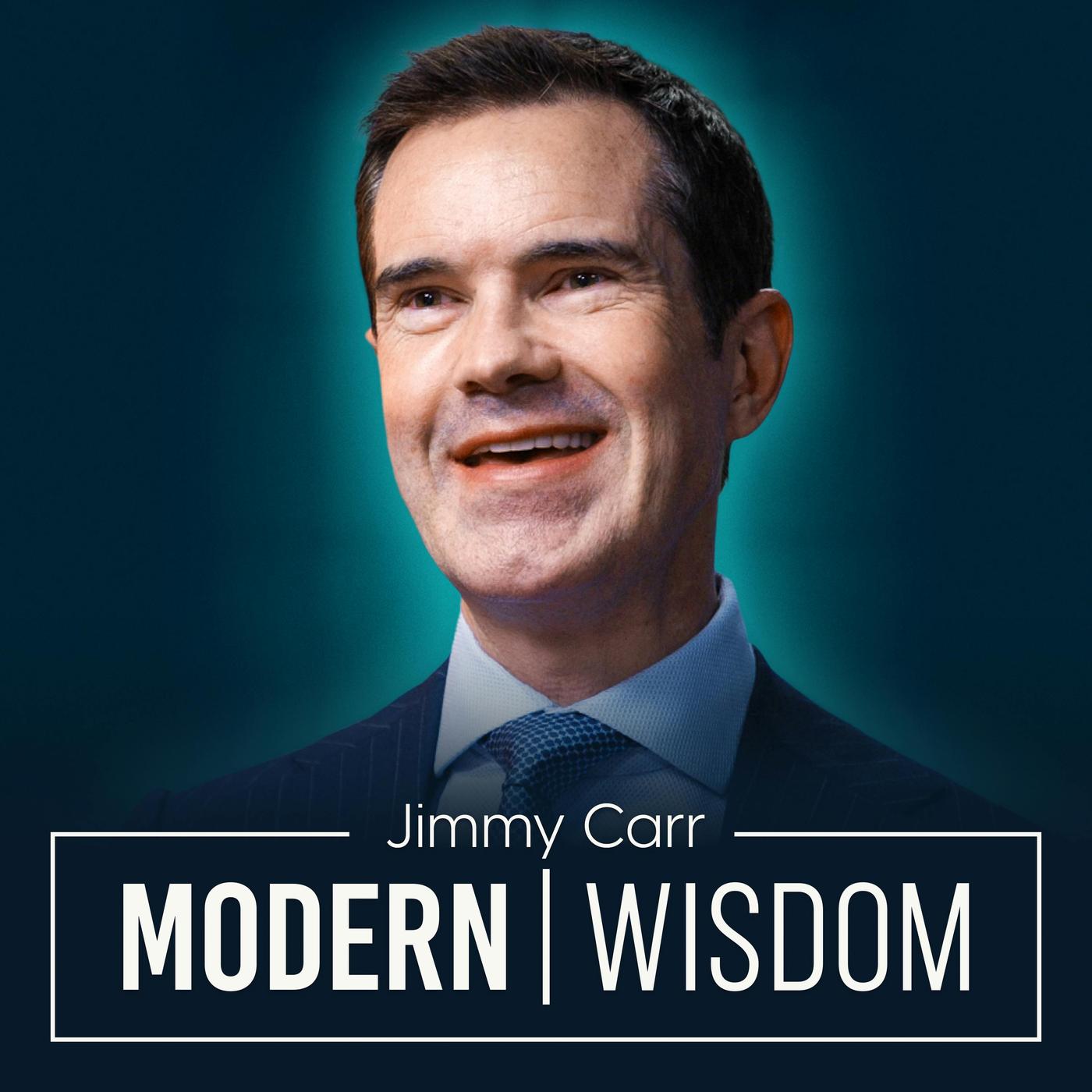
Aug 10, 2026 · 1h 59m
Jimmy Carr outlines how daily systems and constant iteration cure modern anxiety
You’re Not Depressed, You’re Living The Wrong Life - Jimmy Carr - #1135
This episode reframes mental health struggles not as individual failures, but as systemic issues that can be solved through structured habits and community.
- 1Constant iteration and high-frequency performance reduce performance stress by shifting the mind into a flow state.
Don't miss
Jimmy Carr explains how performing up to 300 shows a year actually lowers his stress levels through rapid iteration.
The brief
Comedian Jimmy Carr argues that modern anxiety is often the result of living a life misaligned with one's natural drive, suggesting that constant iteration and structured routines are the best remedies for mental fatigue.
Rather than setting distant goals, Carr advocates for building daily systems that leverage compound interest on personal skills, using his own rigorous touring schedule of up to 300 shows a year as a blueprint.
The discussion broadens to societal challenges, where Carr applies his philosophy of radical realism to propose practical solutions for the UK economy, energy costs, and the global drug rehabilitation crisis.
Ultimately, Carr suggests that redirecting obsessive or compulsive behaviors toward productive creative outlets, combined with a strong sense of community, is the ultimate antidote to modern isolation.
What was said on this episode
42 statements · 20 positive · 16 negative · 3 mixed · 3 neutral
Performing many shows reduces nervousness.
“doing that many shows makes you less nervous”
Listen at 0:55
Repeated comedy performances are intellectually stimulating because they involve continual iteration.
“it's never repetition, it's iteration”
Listen at 3:42
Anxiety consists of uncontrolled thought.
“anxiety is thought without control”
Listen at 4:22
Finding enjoyable activities that induce flow is a key to wellbeing.
“Finding something that you enjoy doing that you can be in that kind of flow state”
Listen at 4:53
Depression and anxiety are substantially societal rather than purely individual problems.
“you have to conclude that it's a societal problem”
Listen at 5:32
A depressed young man cannot solve the problem entirely alone.
“It's not something that you can solve on your own”
Listen at 5:47
Individualized fitness tracking can be more socially isolating than walking with friends.
“tracking your steps every day rather than going for a walk with a friend, it's very isolating”
Listen at 6:22
The drinking age should be lowered to sixteen.
“We should lower the drinking age to 16”
Listen at 7:41
People under thirty should pay no tax.
“I don't think there should be any tax on the under 30s”
Listen at 9:01
Society is structured in a way that inadequately supports young people’s basic needs.
“we've arranged our society incorrectly then”
Listen at 9:44
Carr associates happiness with present experience, depression with past focus, and anxiety with future worry.
“I think happiness is a time machine. I think depression is. Is thinking about the past and anxiety is a worry about a future self.”
Listen at 10:18
People cannot control events, only their reactions to them.
“You can't have control over what happens, only how you react to it”
Listen at 12:34
Circumstantial low mood is better described as sadness than depression.
“If it's circumstantial, then I think it's sadness”
Listen at 13:06
A university degree has become a luxury item whose value declines when widely held.
“a university degree is a luxury item”
Listen at 14:54
Overproduced elites who feel disappointed can become a counter-elite opposing the system.
“that elite that feels let down by the system and what it tacitly promised them becomes the counter elite”
Listen at 15:40
The UK is entering the beginnings of a revolution caused by elite and institutional fracture.
“I think that's why we're kind of in the beginnings of a revolution at the moment”
Listen at 15:50
Abundance is a more important political objective than equality.
“I'm more concerned with abundance”
Listen at 17:05
Excessive life and career optionality prevents people from committing to action.
“there's too much optionality”
Listen at 21:38
Systems and routines consistently outperform goals alone.
“your goals will be beaten by your systems every time”
Listen at 25:26
Self-confidence arises from repeatedly demonstrating one’s claimed abilities.
“self confidence comes from giving the world irrefutable proof you are who you say you are”
Listen at 29:19
Gratitude is the main factor that changes a person’s disposition.
“the only thing that seems to shift disposition is a sense of gratitude”
Listen at 30:08
Problems are normal and useful because they signal that something needs attention.
“Problems are a feature, not a bug”
Listen at 32:14
Redirecting racing thoughts toward a concrete task can reduce anxiety.
“if I give it like, oh, no, but we need to write a joke about Keir Starmer or Andy Burnham or something. You go, okay, right, right, great. Give it something to do.”
Listen at 34:27
News can worsen mental health by exposing people to problems they cannot influence.
“you'd make someone aware of a problem and give them no agency”
Listen at 35:18
Everyone should receive both empathy and agency rather than only one.
“you should give both. You need agency and empathy for everyone.”
Listen at 36:40
Comedy expands the range of topics people consider acceptable to discuss.
“I think comedy does that for conversation”
Listen at 43:23
A successful comedy show should generate approximately three major laughs per minute.
“For comedy, you want there to be three big laughs a minute”
Listen at 46:32
Taking roughly a thousand photos daily can alienate people from their identity.
“a thousand a day. That'll do it. That'll absolutely do it. That will break you away from who you are.”
Listen at 48:42
People will surrender their power through cheap digital dopamine rather than external coercion.
“Our power will not be taken from us by some overlord. I think we'll give it away for cheap dopamine.”
Listen at 49:08
New technologies will ultimately improve society despite transitional difficulties.
“I think it will be, ultimately the trajectory will be up and it'll be better”
Listen at 50:04
AI handles complicated analytical tasks better than holistic comprehension.
“AI is really good at left brain shit. Really good at left brain stuff. But the Right brain stuff and the left brain apprehends, but the right brain comprehends. It's all Ian McGilchrist's stuff. And that idea that you go the gestalt, the whole, the complex stuff it can't do.”
Listen at 51:20
AI will remove some routine white-collar labor.
“this is taking away some of the drudgery of white collar work”
Listen at 52:42
The UK should devalue the pound to improve national competitiveness and exports.
“if I was in charge, right, if I was in charge for the day, I devalue the currency, I devalue the pound. I think the pound's overvalued.”
Listen at 1:01:43
The UK’s energy costs are approximately four times higher than America’s.
“We have the most expensive energy in the world. I think it's like four times higher than America”
Listen at 1:02:43
France’s large nuclear buildout helped give it Europe’s cheapest energy.
“France in the 1970s built 56 nuclear plants. They've got the cheapest energy in Europe.”
Listen at 1:03:13
Suicide fails to eliminate suffering and instead transfers pain to surviving loved ones.
“suicide doesn't work”
Listen at 1:08:22
Five major films account for approximately ninety percent of box-office revenue.
“five big movies a year that dominate like 90% of the box office”
Listen at 1:15:03
Comedy writing should be taught in schools as a valuable life skill.
“that strikes me as an incredibly worthwhile activity that should be taught in schools”
Listen at 1:16:02
Developing competence is an important source of happiness.
“when are people happy? When they're getting good at stuff. I think competence is such an important thing for people to get good at something.”
Listen at 1:33:44
Happiness depends substantially on freedom and purpose.
“happiness being, it's freedom and purpose”
Listen at 1:51:01
Rapid fossil-fuel reduction is difficult short-term and disproportionately harms poorer people.
“net zero is a really good example of that of like going, well, we have to decrease our reliance on fossil fuels. But in the short term that's very, very difficult to do and it affects the poor disproportionately.”
Listen at 1:55:32
Near-zero energy costs would attract businesses to the UK.
“if you get energy down to essentially zero cost, how many businesses would that attract to the UK”
Listen at 1:56:26
Statements are attributed to the speaker as said on the episode and reflect their view at the time, not PodLume's. They are not advice.
What people are saying
Jimmy Carr’s episode goes hard, but one listener questions the name-dropping
Episode reactions
- One listener says the Jimmy Carr episode “goes hard.”
- A listener initially praised Carr’s policy ideas, then questioned the heavy name- and quote-dropping.
- Carr’s discussion of estranged parents prompted a personal response from someone who related to absent family.
Wider topic conversation
- Wider results are dominated by unrelated Jimmy Carr comedy clips, political posts, and generic references to depression.
- The episode’s themes of purpose, isolation, and changing direction receive little independent discussion beyond promotional summaries.
Featuring
 Jimmy Carr
 Flow (psychology)
 Compound interest
 Comedy
Books & mentions
Listen to the full episode and explore every guest, topic, and moment on PodLume.