
Sep 18, 2026 · 39 min
Isaacman pushes NASA toward a lunar proving ground
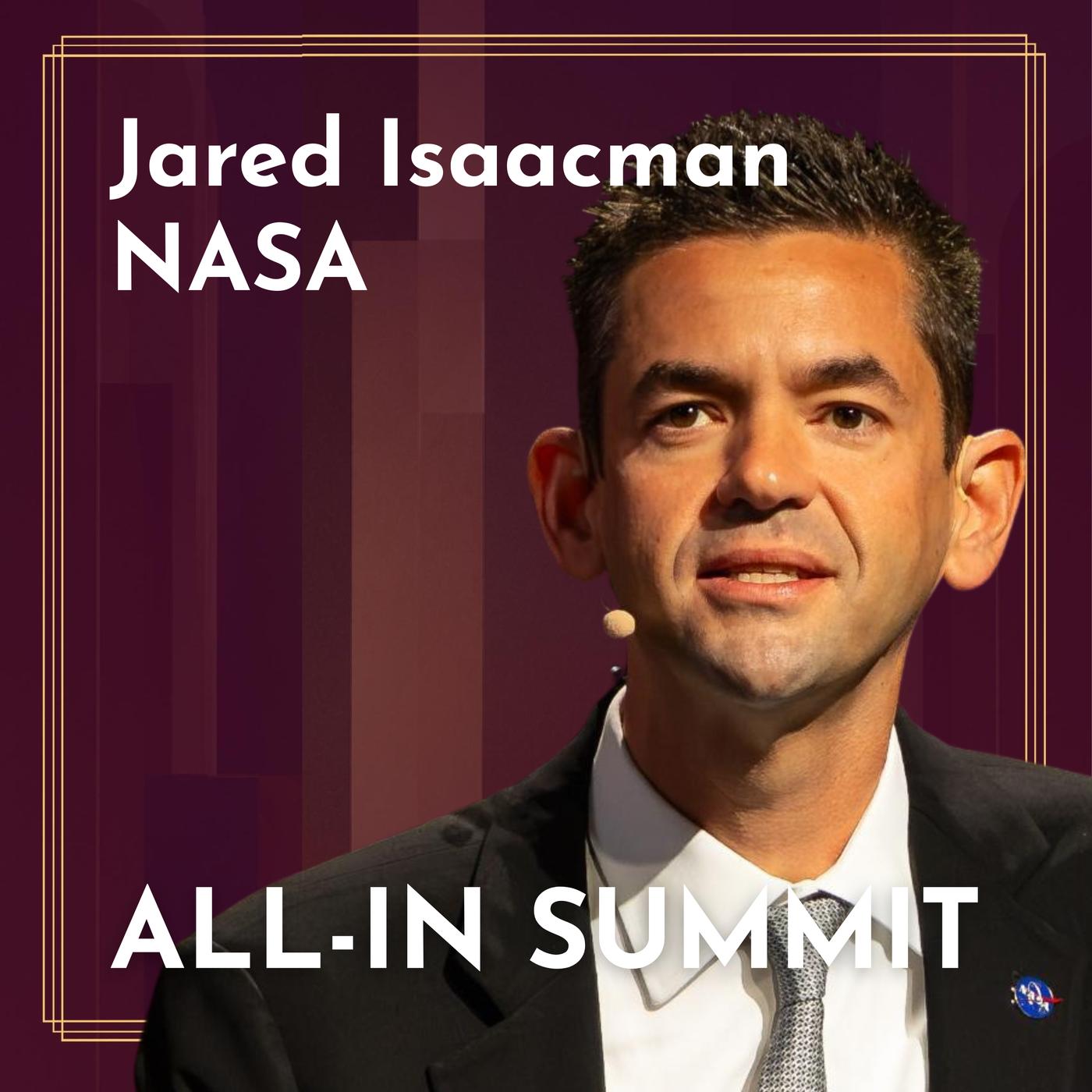
Jared Isaacman: A New Era for NASA and American Space Exploration
The debate captures a consequential choice for NASA: spread resources across competing priorities or concentrate them on lunar infrastructure, Mars preparation, and strategic competition with China.
- 1Isaacman sees the Moon’s South Pole as a testbed for habitats, robotics, power systems, and resource utilization.
- 2He argues NASA’s central weakness is inefficient capital allocation, not its roughly $25 billion annual budget.
- 3Nuclear propulsion could extend American exploration beyond the limits of solar-electric systems and support deeper-space missions.
Don't miss
Isaacman explains how nuclear thermal and nuclear-electric propulsion could overcome solar power’s limits for missions farther from the Sun.
The brief
Jared Isaacman frames NASA’s future around extending human reach beyond Earth, with nuclear power and propulsion as essential technologies for a more ambitious exploration program.
The Moon’s South Pole becomes the proposed proving ground: its water ice and limited landing sites could test habitats, robotics, power systems, and resource utilization before Mars missions.
Isaacman argues NASA needs sharper priorities and better capital allocation, while preserving science, aeronautics, human exploration, and partnerships with commercial space companies.
The conversation’s technical centerpiece is nuclear propulsion: solar power weakens farther from the Sun, while nuclear thermal and electric systems could enable deeper-space missions.
A planned 2028 mission featuring three Mars helicopters with ground-penetrating radar illustrates the proposed strategy: pair autonomous systems with nuclear-powered spacecraft and clear objectives.
What was said on this episode
42 statements · 29 positive · 8 negative · 1 mixed · 4 neutral
Humanity will eventually expand beyond Earth.
“Humankind will not be contained to planet Earth indefinitely.”
Listen at 0:13
Nuclear power and propulsion are the next major spaceflight capabilities.
“the next giant leap capabilities, that's nuclear power and propulsion.”
Listen at 0:17
Nuclear power and propulsion will extend America’s reach through the solar system.
“That's what extends America's reach farther into the solar system.”
Listen at 0:20
Fusion energy has significant future promise.
“the promise of fusion energy.”
Listen at 1:18
Converging technologies will fundamentally change society, warfare, and space exploration.
“Our world will fundamentally change how we live, how we work, how we fight wars, how we reach out and touch the stars.”
Listen at 1:33
NASA is currently regaining momentum and achieving successes.
“we are regaining our swagger and putting wins on the board.”
Listen at 2:06
Mars Sample Return was projected to cost more than an aircraft carrier.
“the prior administration canceled the Mars Sample Return mission that was on track to cost more than an aircraft carrier.”
Listen at 2:48
NASA’s current Moon rocket is less payload-efficient than Saturn V.
“our Moon rocket is in fact less efficient than Saturn V at converting launch mass into payload headed for the Moon”
Listen at 3:52
NASA will fly again in less than three years after Artemis II.
“We are not waiting 3 years to fly again.”
Listen at 6:18
Artemis III will roll out for a tanking test before year-end.
“Before year-end, we intend to roll out to Launch Complex 39B for a tanking test”
Listen at 6:30
Artemis III will launch on SLS in summer 2027.
“in the summer of 2027, Artemis III will launch on SLS into low Earth orbit”
Listen at 6:55
American astronauts will return to the lunar surface in 2028 and remain there.
“Artemis IV in 2028, when American astronauts return to the lunar surface, and this time to stay.”
Listen at 7:20
NASA is establishing humanity’s first outpost on another world.
“we are establishing humanity's first outpost on another world, a Moon base”
Listen at 7:35
NASA will launch lunar missions nearly every month.
“We will launch missions on a near-monthly cadence”
Listen at 7:46
The lunar south pole will serve as a proving ground for Mars missions.
“the lunar south pole, where the water ice is, is going to be the technological proving ground for where we inevitably go next, which is Mars.”
Listen at 8:18
NASA will launch the 100-kilowatt SR-1 Freedom fission reactor in 2028.
“In 2028— in 2028, NASA will leave decades and billions of dollars of failed nuclear programs behind and launch SR-1 Freedom, a 100-kilowatt fission reactor”
Listen at 8:28
SR-1 Freedom will transit Mars and release three Ingenuity-class helicopters.
“The mission will transit Mars and release Skyfall, which carries 3 Ingenuity-class helicopters”
Listen at 8:44
A taxpayer-funded model alone cannot realize the imagined future of space.
“the future in space that we all imagined as children will never be realized if they're perpetually funded by taxpayers.”
Listen at 12:06
NASA should support the development of orbital and potentially lunar economies.
“NASA will do everything within reason to support an orbital and perhaps even lunar economy someday”
Listen at 12:13
China intends to land astronauts on the Moon by 2030.
“China intends to put their astronauts on the Moon by 2030.”
Listen at 14:53
China will achieve a lunar milestone the Soviet Union failed to achieve.
“China will accomplish what the Soviets never could during the first space race.”
Listen at 15:11
NASA is currently in a substantially improved organizational state.
“We are in a different state today.”
Listen at 22:34
Chemical propulsion systems such as Starship can send astronauts to Mars.
“you will no doubt have the means to send astronauts to Mars.”
Listen at 23:58
Chemical-propulsion Mars missions will need to produce return propellant on Mars.
“You're going to need to make propellant on Mars to do so.”
Listen at 24:13
Nuclear-electric propulsion could enable Mars vehicles to return without surface refueling.
“Then you can have chemically augmented NEP spaceships, transfer vehicles, and go to and from Mars, and you don't need to refuel them until they come back.”
Listen at 24:58
NASA currently does not have an initial recruiting problem.
“we don't have a recruiting problem initially.”
Listen at 25:49
NASA will develop a large fleet of nuclear-powered frontier spacecraft.
“There will be a grand fleet of nuclear-powered, uh, spacecraft on the frontier.”
Listen at 26:33
Solar power becomes negligible for spacecraft near Jupiter.
“once you get out towards Jupiter, I mean, solar effectiveness is, is negligible.”
Listen at 27:33
NASA’s main budget problem is poor capital allocation, not insufficient funding.
“NASA does not have a top line problem. Like, we are bad capital allocators.”
Listen at 28:15
NASA has approximately $25 billion in funding.
“We have $25 billion.”
Listen at 28:26
NASA should prioritize radical airframe and engine designs over incremental upgrades.
“I want to get back to the radical airframe and engine designs like we were always supposed to do.”
Listen at 29:45
Some high-radiation environments can only be explored with uncrewed robotic missions.
“there are some environments that just whether it's the radiation that we can only do uncrewed, you know, robotic missions”
Listen at 30:43
Robotics will play a critical role in human expansion through space.
“robotics will absolutely play a critical role in that journey.”
Listen at 30:57
Crewed and uncrewed spacecraft will increasingly incorporate autonomy.
“that will inevitably include more autonomy in our, in our crewed and uncrewed spacecraft.”
Listen at 32:38
Science accounts for approximately one-third of NASA’s budget.
“science is, uh, approximately, call it a third of NASA's budget.”
Listen at 33:06
NASA should prioritize launching new missions over funding additional researchers.
“I would always prioritize getting new missions out there to unlock the secrets of the universe versus the researchers.”
Listen at 34:01
NASA will send three Mars helicopters equipped with ground-penetrating radar.
“Now we're going to send 3 of these with ground penetrating radars”
Listen at 34:59
The nuclear-powered Mars helicopter mission will launch in 2028.
“This will launch in '28.”
Listen at 35:11
China currently has highly capable space capabilities.
“The Chinese are extremely good in space right now.”
Listen at 37:19
China and Russia will return to the Moon and build a south-pole base.
“they will return to the moon and they will get to the moon and they will build a base on the South Pole.”
Listen at 37:24
SpaceX is NASA’s most important launch partner.
“they're our most important launch partner.”
Listen at 37:35
Without SpaceX, the United States would face serious space-domain challenges.
“the United States would be seriously challenged in the high ground of space without their capabilities.”
Listen at 37:54
Statements are attributed to the speaker as said on the episode and reflect their view at the time, not PodLume's. They are not advice.
Featuring
 Jared Isaacman
 Moon
Moon Orion
Orion Apollo 11
 Mars Sample Return
Listen to the full episode and explore every guest, topic, and moment on PodLume.