
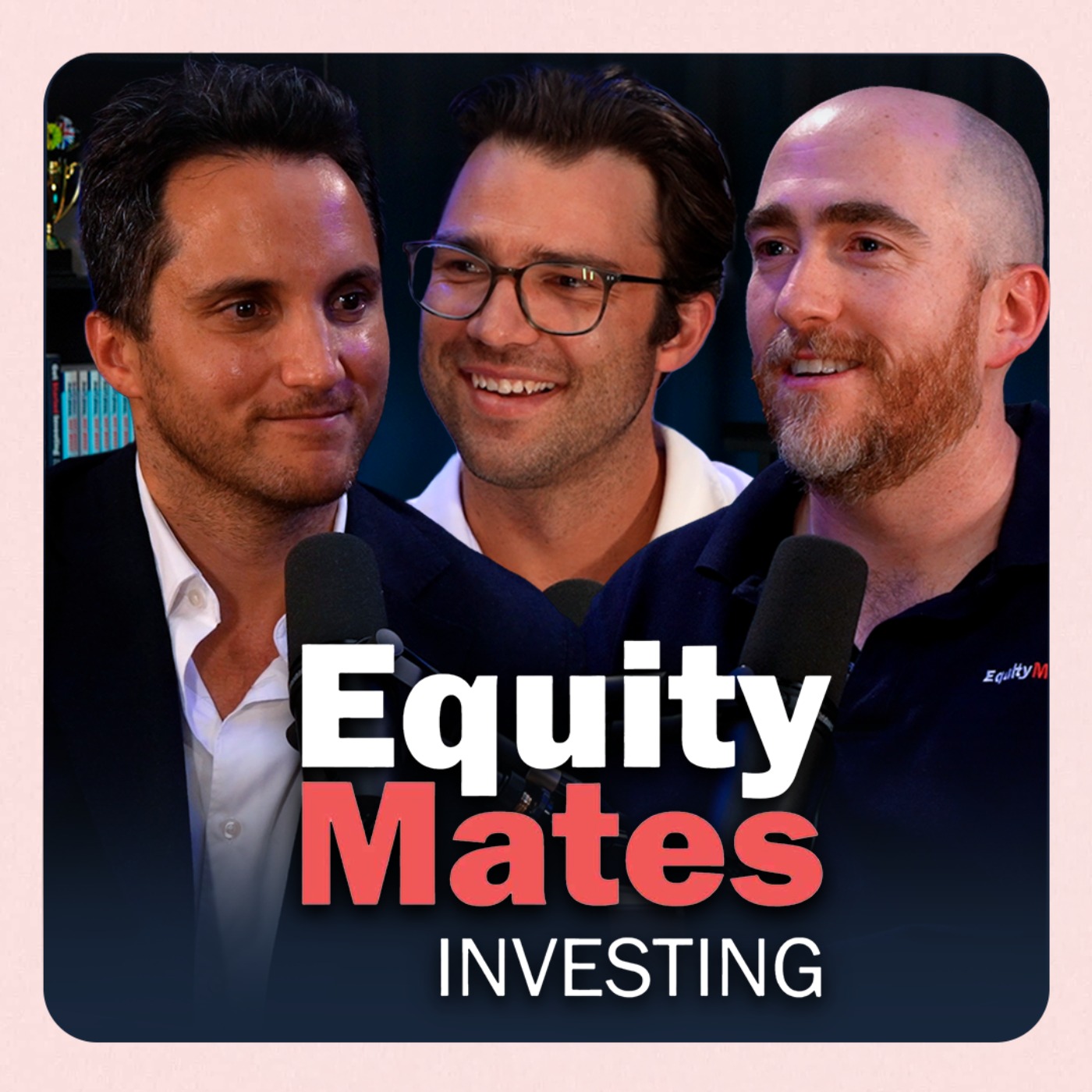
Sep 3, 2026 · 49 min
AI spending strains markets as growth investors rethink risk
Knowing when to sell: How growth investor Michael Frazis manages risk
The episode connects AI infrastructure’s uncertain economics with a disciplined investing framework built to capture growth while limiting drawdowns.
- 1Massive AI infrastructure spending, leverage and circular financing could remove market stability and amplify volatility.
- 2Michael Frazis now combines growth fundamentals with trend following, profit-taking, downside exits and substantial cash positions.
- 3Cheaper local AI models, software recoveries and healthcare breakthroughs are reshaping where investors may find durable growth.
Don't miss
Michael Frazis explains why his strategy can hold more than 50% cash when trends weaken, rather than defend every growth position through a downturn.
The brief
Michael Frazis argues that hyperscalers’ borrowing and equity raising for enormous AI infrastructure projects could weaken a traditional source of market stability and make volatility more persistent.
The AI trade faces pressure from expensive hardware, circular financing and cheaper models such as Alibaba’s Qwen, which could shift demand from cloud providers toward local systems.
Apple’s efficient hardware and on-device models offer a contrasting position: it may benefit from AI advances without matching peers’ infrastructure spending.
After the growth-stock sell-off of 2022 and 2023, Frazis moved from buy-and-hold investing to a quantitative approach that scales out of winners and exits weakening trends.
The ROAR strategy still seeks companies capable of 40% to 50% growth, especially in semiconductors, software and healthcare, but can move more than half the portfolio into cash.
What was said on this episode
42 statements · 21 positive · 16 negative · 5 neutral
AI infrastructure and semiconductor stocks are currently under pressure
“it seems like AI is under a bit of pressure”
Listen at 2:49
Software growth stocks have recently begun recovering
“it seems like there's been a bit of recovery in software”
Listen at 3:00
Extreme leverage eventually causes an investment strategy to fail
“there's no way you can run that kind of leverage without blowing up at some stage”
Listen at 5:17
Leveraging illiquid, lower-quality stocks increases strategy risk
“if you're levering into kind of junkier things, illiquid names”
Listen at 6:49
Triple-leveraged single-stock products are likely to eventually lose all value
“the ending of every single triple levered stock is probably zero”
Listen at 9:22
Reduced hyperscaler buybacks will make markets less stable
“no matter what it's going to be a much less stable environment going forward”
Listen at 10:22
Highly leveraged market participants will eventually be forced out
“heavily leveraged players will probably be cleaned out at some point”
Listen at 10:34
Hyperscalers will prioritize designing and using their own chips
“they're going to, over the next two to three years, it's going to be their primary strategy”
Listen at 11:39
Hyperscalers’ custom chips pose a long-term threat to NVIDIA
“long term, that is absolutely a threat to NVIDIA”
Listen at 12:02
Hyperscaler-designed chips will gain market share from NVIDIA
“they'll continue to take market share over the next two to three years”
Listen at 12:17
Locally runnable AI models will improve within six to twelve months
“in six to 12 months, these are going to be even better”
Listen at 13:44
Companies will increasingly run capable AI models on their own hardware
“they can just run on their own hardware”
Listen at 14:21
Local AI models could undermine major AI companies’ valuations and spending plans
“where does that leave the multi-trillion dollar valuations of these companies and their spending plans?”
Listen at 14:28
Apple benefited strategically by avoiding massive AI capital expenditure
“they played it perfectly”
Listen at 15:56
Apple can leverage competitors’ AI investment without matching their spending
“They can leapfrog on all the investment of everybody else.”
Listen at 16:00
Software companies maintaining 20–25% growth may outperform through year-end
“The ones that accelerate and are able to accelerate or even just maintain, you know, 20%, 25% growth are probably going to be really strong performers for the rest of the year”
Listen at 18:22
Xero is relatively vulnerable to disruption over the medium term
“they're probably on the more disruptable side”
Listen at 19:24
Cybersecurity companies are attractive growth investments
“Cybersecurity is obviously a pretty easy one.”
Listen at 19:54
Any hackable application or system will eventually be hacked
“Anything that can be hacked will be hacked.”
Listen at 20:12
AI has not yet produced mass unemployment
“you haven't seen mass unemployment”
Listen at 21:00
AI has not materially increased GDP growth apart from investment spending
“GDP growth hasn't really moved other than there's been this big boost in investment”
Listen at 21:10
Explosive growth and customer love remain the best growth-investing framework
“that is the best framework”
Listen at 22:46
NVIDIA sustained roughly 100% growth for three years before slowing
“Nvidia. So that one maintained 100% growth for basically three years and maybe 50, 60% this year.”
Listen at 24:18
Holding all 2021 growth-stock positions would not have produced comparable recovery
“if we held everything we owned in 2021 we wouldn't have recovered the way we did”
Listen at 25:18
Frazis Capital Partners now uses quantitative trend-following to select holdings
“Now we're very quant-based in terms of how we trade and what we actually own. So it's very much trend following.”
Listen at 25:43
Trend following can capture major gains while avoiding major crashes
“you capture the big trends, so you make a lot of money, and then you avoid the big crashes”
Listen at 26:09
The strategy typically trades each position one to three times annually
“most things we trade one to three times a year”
Listen at 26:49
Backtested NVIDIA trend following tripled returns and halved drawdown
“you have like tripled your return and cut your draw down in half”
Listen at 26:57
A four-times profit target historically produced the best returns
“4X gives you the best return”
Listen at 29:34
The strategy moved more than half its portfolio into cash three times
“three times in the last three and a half years, we've moved over 50% cash”
Listen at 30:07
ROAR focuses on semiconductors, software, and healthcare
“it's semiconductors, software and healthcare”
Listen at 30:48
Companies capable of two-to-four-times returns often grow 40–50% annually
“the company's growing at 40, 50%”
Listen at 31:29
Selling all expensive stocks would likely miss major market rallies
“if you sold everything that was expensive, you probably missed some of the bigger rallies”
Listen at 33:03
OpenAI is currently gaining market share
“OpenAI is taking share”
Listen at 36:15
AI models will become substantially more efficient within several years
“huge efficiencies that will come in the next couple of years”
Listen at 38:38
Local AI adoption could substantially alter cloud demand
“That could change it all.”
Listen at 38:45
GLP-1 medicines will continue expanding strongly
“the GLP ones, they're clearly just going to continue to power on”
Listen at 39:41
Prior melanoma trials reduced recurrence by approximately 50% and extended life
“it was reducing that recurrence by like 50%, extending life”
Listen at 40:51
Personalized cancer vaccines will be broadly rolled out and generate billions annually
“they'll roll it out they'll make billions of dollars a year probably out of it”
Listen at 42:26
Genetic profiling of tumors will likely become commonplace
“that will probably become commonplace now”
Listen at 43:09
Tempus AI will likely benefit substantially from personalized cancer treatment
“Tempest AI, which is probably going to be a big beneficiary”
Listen at 43:21
Daraxonrasib approximately doubles survivability in pancreatic cancer
“it's kind of extending life by doubling survivability”
Listen at 44:08
Statements are attributed to the speaker as said on the episode and reflect their view at the time, not PodLume's. They are not advice.
Featuring
 OpenAI
 Anthropic
 Apple Inc.
 Nvidia Corporation
Listen to the full episode and explore every guest, topic, and moment on PodLume.