
Aug 4, 2026 · 1h 13m
White House policy veteran outlines plan to supercharge American scientific productivity
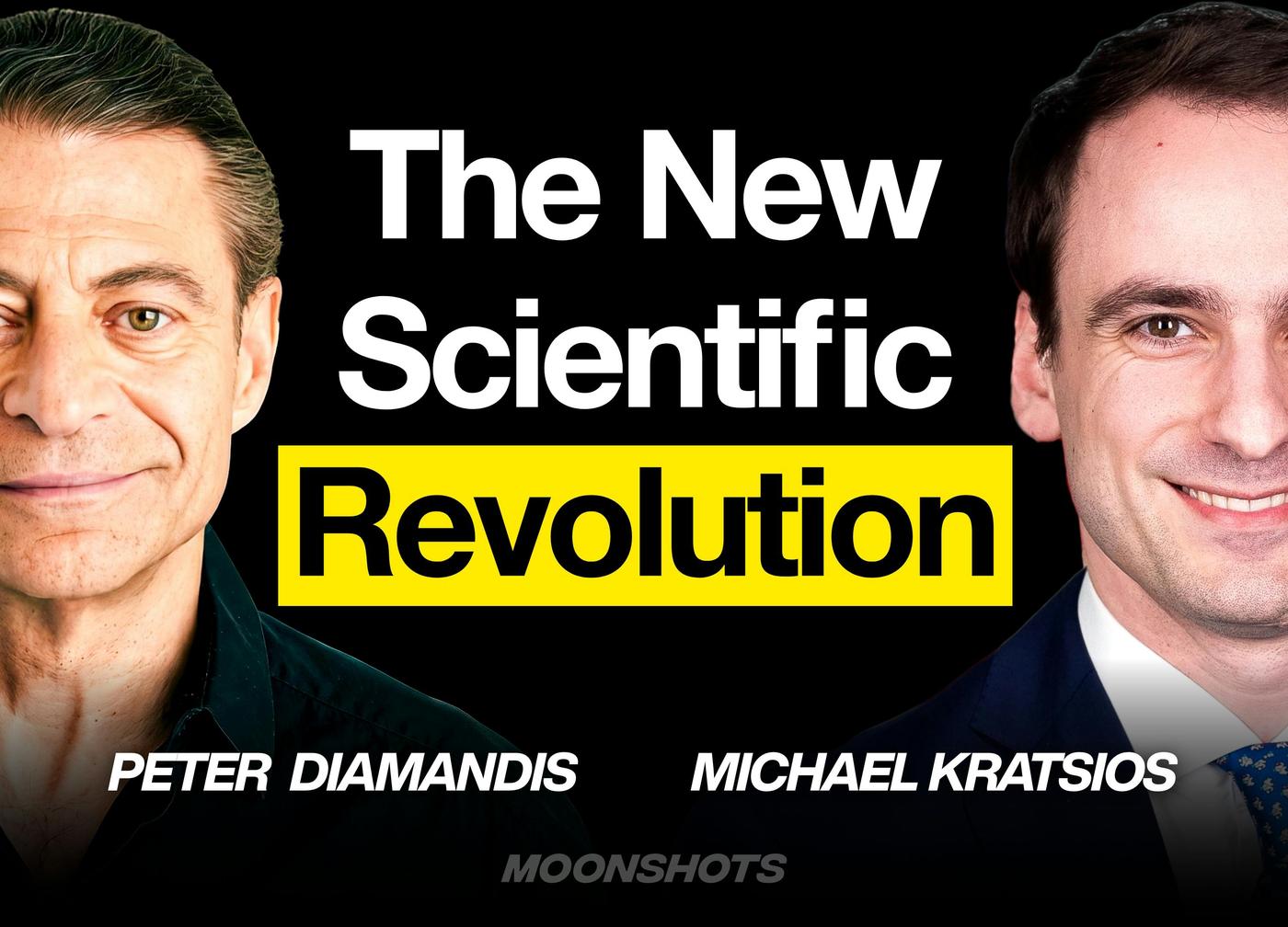
Michael Kratsios on the New Golden Age of American Science | EP #276
As global technological competition intensifies, the United States must reform its scientific funding and regulatory frameworks to avoid stagnation in critical fields like AI and robotics.
- 1Overbearing administrative and regulatory requirements are actively stifling domestic scientific productivity and slowing breakthrough research.
- 2New funding mechanisms like fast-track approvals and high-risk golden tickets can revive stagnant research sectors.
- 3Deploying autonomous laboratories and integrating federal data into AI models will democratize scientific experimentation nationwide.
Don't miss
Michael Kratsios explains his regulatory philosophy of allowing emerging technologies to be born free rather than born in captivity.
The brief
Former White House CTO Michael Kratsios joins Peter Diamandis to outline a bold blueprint for stripping away regulatory and administrative bloat, aiming to trigger a tenfold acceleration in American scientific productivity.
Kratsios argues that breakthrough technologies should be born free rather than born in captivity, warning that premature government regulation risks crippling vital domestic industries like robotics and artificial intelligence.
The discussion centers on the Golden Age report, which exposes how scientific progress has stagnated due to funding bottlenecks, and proposes radical reforms like fast-track grants and high-risk golden tickets.
To supercharge research, they explore the potential of autonomous, self-driven laboratories and regional innovation hubs that can democratize complex experimentation for students and researchers across the nation.
What was said on this episode
39 statements · 30 positive · 7 negative · 2 neutral
AI will affect every government agency.
“AI is a technology that is going to impact every agency.”
Listen at 0:18
Government should avoid regulating technologies that develop freely.
“the best thing that the government can do in those situations is to step back, get out of the way, don't jump into it.”
Listen at 3:38
Policymakers should be cautious before regulating artificial intelligence.
“You know, be. Be careful before you start, before you start regulating.”
Listen at 3:59
Government action is necessary to commercialize regulated technologies such as drones and medical diagnostics.
“These are technologies that cannot be commercialized. They will not be. Their benefits will not be realized by the American people unless the government affirmatively does something.”
Listen at 4:38
Centralizing AI policy in one official is unlikely to produce the best answers across agencies.
“The idea that you can sort of like, centralize that effort in one person and be able to get the right and best policy answer across all those domains, I think is a tall, tall order.”
Listen at 7:09
The White House currently restricts large-language-model use because of records-law concerns.
“large language models are not allowed for use on our, on our, on our system here because of Presidential Records act, but hopefully we'll change that soon.”
Listen at 7:57
Artificial intelligence currently has a major public-relations problem.
“AI has a massive PR problem”
Listen at 9:37
Demonstrating AI’s healthcare benefits could reduce public skepticism toward AI.
“if we can actually show the impact in changing the way that individual individuals themselves get health care, their families get health care, I mean, those are the places where I think you can start to push back a little bit on that narrative.”
Listen at 11:16
Government can improve AI’s public image by highlighting beneficial industry outcomes.
“I think the government can serve as a convener to bring to the surface all the great stories that are going on around this industry.”
Listen at 11:59
AI will have a positive long-term impact on employment.
“in the long term, I'm very optimistic about the impact that AI is going to have have on jobs.”
Listen at 13:27
Current data on AI’s labor-market impact is inadequate.
“the data around what is actually happening is not very good.”
Listen at 14:00
The government should prioritize major national missions.
“we as a government need to be opinionated about what the most important things are for the future of our nation.”
Listen at 16:39
The United States plans lunar return, a lunar base, and a space nuclear reactor by 2028–2030.
“We're going putting man back on the moon in 28. We're going to be able to build the first elements of a lunar base by 30. We're going to put a nuclear reactor in space by 28.”
Listen at 17:16
Genesis aims to double U.S. scientific productivity within a decade.
“We essentially want to double the productivity of the entire scientific enterprise in the United States over the next decade.”
Listen at 17:53
The administration aims to create a scientifically relevant quantum computer by the president’s term end.
“create a scientifically rough, relevant quantum computer by the end of his term.”
Listen at 18:06
Quantum computing could transform pharmaceutical research through molecular calculations.
“pharmaceuticals is where I'm most excited about. I do honestly believe that the types of calculation you can run on those for particular molecules and things that you want to apply towards, toward drugs is going to be pretty transformational.”
Listen at 18:43
The United States should lead globally in both closed and open AI models.
“the US must lead the world both in closed and open source models”
Listen at 20:01
The United States currently has the world’s strongest AI technology stack.
“we have the best AI stack in the world.”
Listen at 22:21
The U.S. lead over China in advanced chips is increasing annually.
“our lead over where the best Chinese chip is continues to increase year over year.”
Listen at 23:44
Restricting Nvidia chip exports constrained China’s ability to develop competitive AI models.
“that was probably one of the savviest decisions that we made as administration and I think it was probably one of the most impactful in being able to throttle their ability to make competitive models to ours.”
Listen at 25:09
Humanoid robots are critical to America’s future and advanced manufacturing.
“these robots are critically important for the future of the country, for advanced manufacturing, for so many other things.”
Listen at 28:16
Scientific institutions are stagnating because they do not experiment enough with research methods.
“we just are not experimenting enough in the way that we conduct science.”
Listen at 32:48
Researchers spend 45% of their time on grant-related administration.
“45% of the time that a researcher spends is to do the administrative work associated with their grant.”
Listen at 33:58
The United States is replacing its supersonic flight speed limit with a noise limit.
“we are now changing that rule to create a noise limit rather than a speed limit.”
Listen at 35:04
Rapid scientific grantmaking should not be limited to crisis periods.
“there's no reason it should be restricted Only in times of crisis”
Listen at 39:03
Golden-ticket grants encourage researchers to submit higher-risk ideas.
“you incentivize people to have a little crazier ideas because you have a chance that if one person believes in you, you'll go forward.”
Listen at 40:35
Research-funding mechanisms should be experimentally evaluated and iteratively improved.
“we need to run the experiment like, let's do some fast track grants and let's see, what are the types that work, what are the ones that aren't, and then update”
Listen at 42:15
Technical systems could better align incentives in scientific research.
“I think it really is. And I think what, what we try to get at there in the report, or I do is is I think incentives aren't always that easily aligned in the current system we have today. And over time we have technical solutions to be able to bring those incentives together”
Listen at 44:03
Most U.S. research and development is privately performed, with federal funding at about 30%.
“Today the majority is done in the private sector and only about 30% is funded by the federal government.”
Listen at 45:47
A $100 million government prize is feasible for a sufficiently large project.
“I think in the range of 100 million is certainly doable if the project is big enough for sure.”
Listen at 48:20
Longevity research is important and should be included in national science priorities.
“we probably should have included it. I think it's something that's critically important and I think it ties. Ties to just general health of Americans.”
Listen at 49:44
Demis Hassabis seriously believes AI could cure all diseases within a decade.
“He's dead serious. And I think he thinks it's possible with where AI is going.”
Listen at 50:30
Much federal biotech work is currently incorporated into the Genesis Mission.
“I think a lot of the biotech work has been nested under the Genesis mission”
Listen at 51:57
Federal funding should build autonomous laboratories and support experiments there.
“We believe that we should be building these and being able to use federal dollars to test experiments on these labs.”
Listen at 1:01:34
Universities will likely be among the first institutions to build autonomous laboratories.
“I think universities are going to be probably one of the first folks to build these labs.”
Listen at 1:03:28
The Genesis Mission should target tenfold rather than twofold scientific productivity gains.
“we should definitely be, definitely be pushing for 10. And I think even if you think back to sort of early this year, OPUS wasn't even out yet.”
Listen at 1:05:30
AI will dramatically accelerate discovery and hypothesis testing across scientific fields.
“we believe that every scientific domain, whether you're in chemistry or physics or math or biology, you're going to see this dramatic transformation and acceleration of discovery and hypothesis testing and that's going to be because of AI”
Listen at 1:07:29
Federally produced scientific data should be treated as a public good available to everyone.
“those are, those are public goods. That's data that is a public good and anyone can use it.”
Listen at 1:08:37
U.S. regulation should enable American companies to continue producing leading breakthroughs.
“we need to create a regulatory environment that allows them to just keep making the best, best breakthroughs in the world.”
Listen at 1:10:08
Statements are attributed to the speaker as said on the episode and reflect their view at the time, not PodLume's. They are not advice.
What people are saying
Kratsios outlines a plan to double American scientific output within a decade
Wider topic conversation
- The Genesis Mission would unite all 17 national laboratories and more than 15 federal agencies.
- Kratsios’s science roadmap highlights quantum computing, biotechnology, AI, and reforms intended to accelerate discovery.
- The broader conversation frames the initiative as part of a proposed new golden age of American science.
Featuring
 Michael Kratsios
Mentioned
 White House Office of Science and Technology Policy
 Artificial Intelligence
 Humanoid Robot
 Artificial General Intelligence
Books & mentions
The Golden Age Report
Read the foundational report discussed in the episode detailing how to reform American science policy
Listen to the full episode and explore every guest, topic, and moment on PodLume.