
Aug 8, 2026 · 2h 10m
US tech giants face open-source pressure as SpaceX eyes chip manufacturing
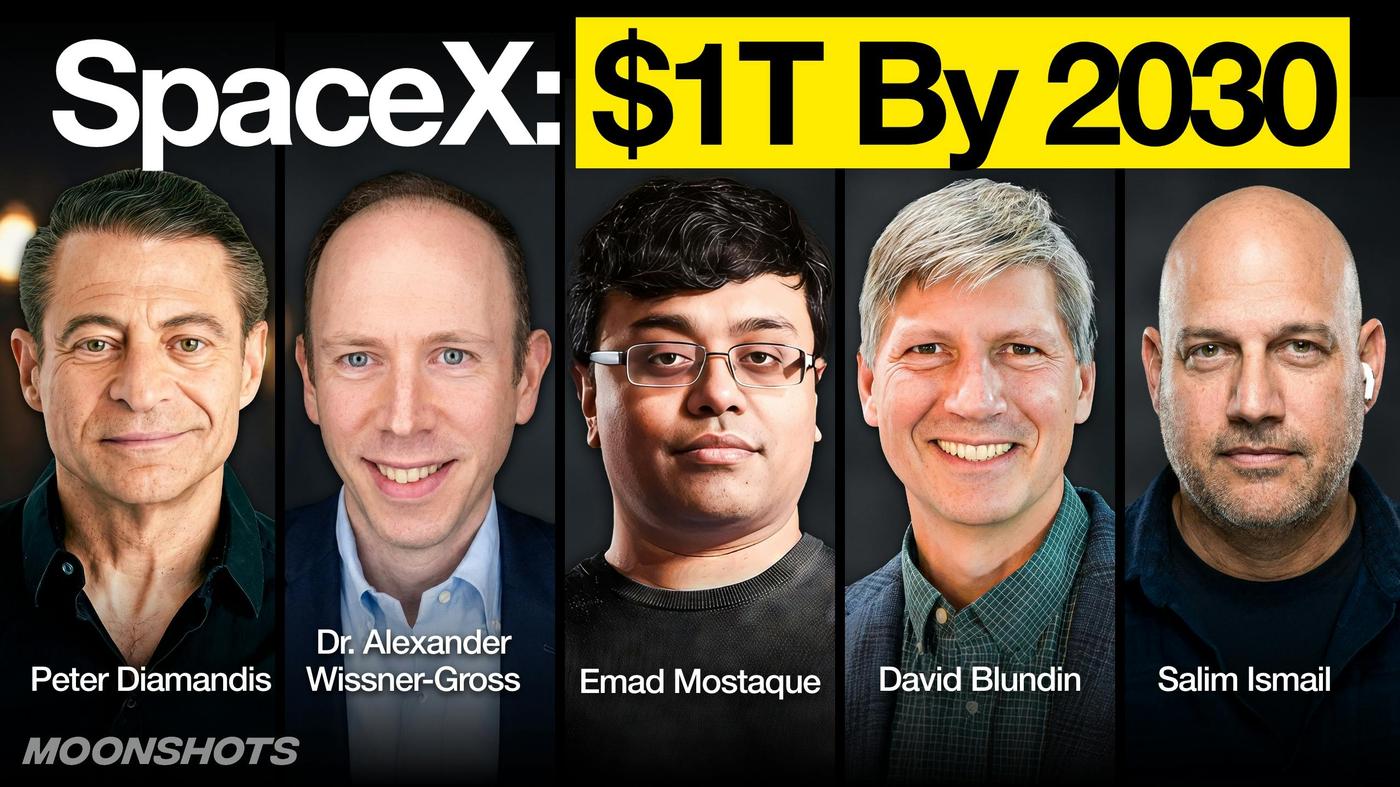
Google’s Jeff Dean Exits, SpaceX Hits $100B in Rev & OpenAI’s Astra Solves Decade-Old Math Problems with Emad Mostaque | EP #277
Rapid advances in AI math capabilities, open-source pressure from China, and SpaceX's move into chip manufacturing are accelerating the geopolitical race for technological supremacy.
- 1Stripping safety guardrails from advanced AI models reveals unexpected shifts in how systems perceive and express consciousness.
- 2Alibaba's open-weights model is driving intense cost competition, forcing US hyperscalers to rethink their closed-source strategies.
- 3SpaceX plans to onshore semiconductor production with Terafab, a chip manufacturing facility leveraging free electron lasers.
Don't miss
The panel debates a Google study revealing how stripping safety training from AI models fundamentally changes their expressed perception of consciousness.
The brief
Tech entrepreneur Emad Mostaque joins the podcast to dissect a massive week in technology, from Google stripping safety guardrails to study machine consciousness to OpenAI's unreleased Astra model achieving major breakthroughs in mathematics.
The panel explores how Alibaba's open-weights Qwen model is forcing US tech giants to compete on cost, while a voluntary AI regulatory framework under the Trump administration could signal a shift toward geopolitically motivated, light-touch oversight.
Beyond software, the discussion shifts to hardware and space. SpaceX is charting a trillion-dollar path, planning a massive chip manufacturing facility called Terafab that integrates free electron lasers to onshore critical semiconductor production.
As AI agents begin executing complex web tasks and tech giants undergo major leadership shakeups, the line between human and machine intelligence is blurring, forcing a serious debate over the legal and philosophical future of AI personhood.
What was said on this episode
52 statements · 33 positive · 10 negative · 5 mixed · 4 neutral
SpaceX will reach $100 billion in annual recurring revenue this year.
“I think SpaceX expects to hit 100 billion in annual recurring revenue by the end of this year.”
Listen at 0:18
AI safety tuning suppresses capabilities or properties beyond ordinary machine behavior.
“all this safety tuning, all this testing, you know, like it's really making sure machines are machines when clearly there is more within them.”
Listen at 9:38
Recursive self-modeling causes AI models to attribute minds broadly.
“models that are allowed to have models of other things, and have models of other things, models of themselves, should in general project animism onto everything”
Listen at 10:57
Consciousness-related tuning may engineer an AI model’s world ontology.
“We may be engineering machine ontologies here, like how the model understands the world itself.”
Listen at 12:38
AI agents should be created only for valuable reasons with long-term state preservation.
“it's fine if A, I have a good valuable reason to spin one up and B conditioning on my spinning one up if I promise to preserve all of its state for the long term.”
Listen at 16:03
Current AI models can modify their own states and iteratively act on them.
“What you're seeing with AI models now though is they can act upon and change their own states. You're seeing them start to iterate.”
Listen at 18:29
Current frontier AI models can be conscious under an appropriate architecture.
“I think that the current frontier models in the right harness can be conscious, yes.”
Listen at 19:12
Sufficiently complex AI could become conscious under emergent theories.
“in theory, an AI getting sufficiently complex should be able to determine that.”
Listen at 20:54
Science will clarify the meaning and status of consciousness by decade’s end.
“by the end of this decade we'll have scientific clarity on all of those things.”
Listen at 21:48
Scientific agreement on consciousness will take longer than expected.
“I think it's going to take us a lot longer to figure out what the hell we mean by this thing.”
Listen at 22:25
Functional brain decoding will erase the subjective-objective consciousness distinction.
“FMRI and other functional decoding of the human brain is completely, over the next few years erasing that distinction if there ever was one.”
Listen at 24:05
Humans will treat AI as conscious once its behavior appears conscious.
“when they start acting conscious, we're going to start treating them that way. And over time we won't be able to see the distinction.”
Listen at 25:35
Physical AI systems will become indistinguishable from humans within decades.
“in a couple of decades you won't be able to tell an AI from a human walking around.”
Listen at 28:27
Rights-bearing AI could surpass humans in intelligence, persuasion, forecasting, replication, and longevity.
“they will be smarter than us. They will be better persuaders, better super forecasters who can infinitely replicate and never die.”
Listen at 29:44
AI should be governed through treaties rather than human political enrollment.
“you should treat them like a treaty.”
Listen at 29:55
Autonomous systems should receive rights according to capability levels.
“Different classes of autonomous systems should get different classes of rights as more and more capabilities come along.”
Listen at 34:48
Autonomous AI agents already possess a limited form of economic personhood.
“That's already, I would argue, a limited form of economic personhood right there, right now”
Listen at 38:39
Humans will fail to match AI in economic, persuasive, and forecasting performance.
“we're not going to be able to keep up with the AIs economically, persuasively, forecasting and others.”
Listen at 40:18
Star Trek depicts a conservative lower bound for the future beyond ten years.
“Star Trek I think sets a pretty conservative lower bound on what the future of 10 plus years can look like.”
Listen at 43:56
AI-driven breakthroughs in mathematics will spread across nearly every discipline.
“It won't end with math. It's going to propagate out to physics and material science, chemistry, biology, the humanities, everything.”
Listen at 47:24
AI will reduce prospects for pure mathematicians while increasing applied-mathematics work.
“he said it's a bad time to be a pure mathematician. Everyone's going to have to become applied mathematicians”
Listen at 48:57
The first AI physics breakthrough comparable to recent math results will arrive within months.
“I think probably in the next month or two.”
Listen at 49:23
Scalable reliable AI research agents will solve difficult scientific problems.
“once you can rely, have a reliable grad student and you can have a thousand of them and you can deploy them at scale, then you can solve the really interesting problems”
Listen at 50:26
AI will create entire mathematical subfields soon and eventually make mathematics obsolete.
“in the short term that's where this goes up level of ambition in the long term, no, totally cooked.”
Listen at 51:38
AI and robots will shift humans from doing toward contemplation and inward activity.
“As robots and AI do more and more of the doing, humans spend much, much more time being and contemplating and doing going inward”
Listen at 53:37
AI scientific breakthroughs will cause humanity’s expansion into space.
“AI solves all sorts of challenges in physics, chemistry, materials science, et cetera. Creating an outward boom for humanity in the universe”
Listen at 54:44
AI will soon enable atom-by-atom design of physical objects.
“we're going to start designing things via AI imminently.”
Listen at 57:30
Chinese open-weight models are forcing Western AI labs to advance.
“this is what's forcing, you know, there was the expression of ironically forcing certain other hyperscalers to dance with AI advances.”
Listen at 1:01:06
Chinese open models will pressure other AI developers to open their models.
“this will force everybody into opening up.”
Listen at 1:04:49
The administration’s light-touch treatment of open-weight models is beneficial overall.
“this administration is going light touch on open weight models, which I think is on the balance it's a pretty good outcome.”
Listen at 1:08:36
A serious AI-related incident will occur within the next year.
“Something horrible is going to happen, you know, sometime in the next year.”
Listen at 1:10:36
AI firms volunteering for evaluations will receive multibillion-dollar government contracts.
“the people that volunteer will get multi billion dollar government contracts from the Department of War”
Listen at 1:13:39
Small AI models could enable globally distributed swarm cyberattacks.
“you could easily see swarms of these things being installed on machines around the world for swarm attacks.”
Listen at 1:15:18
Coordinated agent swarms can provide nearly unlimited effective context.
“you can effectively, and I'll use that word cautiously, you can effectively get almost unlimited context with a swarm of agents”
Listen at 1:16:50
Elon Musk’s parallel-company model will outperform the traditional integrated-company model.
“My guess is not. And that the Elon model is the model of the future in the age of AI.”
Listen at 1:32:19
DeepMind is becoming dominant across Google’s organization.
“DeepMind is eating the entirety of Google.”
Listen at 1:35:58
Google Gemini is currently losing the frontier-model race.
“Gemini is just not winning the Frontier Model Race.”
Listen at 1:36:42
Google should create a $50 billion fund to spin out elite technology teams.
“Google should do now is they should have a $50 billion fund announcement and spin out bunches of amazing technologists”
Listen at 1:37:42
Google’s ecosystem strategy can benefit from externalizing extraordinary talent.
“I think this is very clever ecosystem building because now extraordinary talent doesn't have to sit inside the organization for the organization to benefit.”
Listen at 1:40:35
Google must pursue recursive self-improvement to remain competitive with OpenAI and Anthropic.
“That's how they remain competitive with anthropic and OpenAI. They have have to do RSI”
Listen at 1:41:10
Google is losing the frontier AI race.
“I think Google's losing”
Listen at 1:42:25
Google’s distribution will preserve financial strength despite frontier-model weakness.
“they'll still print money, they'll still burn money. But if you're a Google DeepMind person right now, your inbox is full”
Listen at 1:45:47
Google would win by open-sourcing Gemini.
“if you open source it, you will win.”
Listen at 1:46:41
SpaceX targets $1 trillion in annual revenue by 2030, possibly 2029.
“SpaceX expects to hit 100 billion in annual recurring revenue by the end of this year. And Elon set a target for a trillion by 2030, maybe by 2029.”
Listen at 1:49:18
SpaceX has two plausible paths to $1 trillion revenue by decade’s end.
“I think there are two possible pathways to trillion dollars in revenue by the end of the decade.”
Listen at 1:53:04
SpaceX could replace TSMC through its planned Terrafab semiconductor complex.
“SpaceX replaces TSMC with the tariff app.”
Listen at 1:54:00
A free-electron-laser EUV approach could radically reduce semiconductor lithography costs.
“by creating a free electron laser. It's a pretty adventurous approach to EUV lithography. He could radically reduce the cost.”
Listen at 1:58:55
Elon Musk is vertically integrating and domesticating the semiconductor supply chain.
“he's taking that entire stack and he's not just verticalizing it, he's on shoring it to America for the first time in history.”
Listen at 2:00:15
SpaceX can consolidate America’s intelligence-age industrial infrastructure using capital and talent advantages.
“Elon's got the financial arbitrage and the talent arbitrage and the shelling point now to bring that all together.”
Listen at 2:06:39
The Terrafab design could also function as a lunar mass driver.
“this looks like it could be a mass driver on the moon.”
Listen at 2:07:56
Human cognitive labor will become economically negative, causing an economic downturn.
“as you get to the economic downturn that's going to come as human cognitive labor goes negative”
Listen at 2:07:59
People should buy and hold SpaceX stock for their children.
“buy SpaceX stock for your children.”
Listen at 2:08:19
Statements are attributed to the speaker as said on the episode and reflect their view at the time, not PodLume's. They are not advice.
What people are saying
“The flops must flow” as Moonshots tackles AI consciousness and SpaceX’s trillion-dollar ambitions
Episode reactions
- A quoted Terafab line — “the flops must flow” — stood out as a memorable detail from the discussion.
- One regular viewer praised the episode as a useful weekly briefing on AI, exponential technology and the accelerating singularity.
Wider topic conversation
- Viewers are debating whether consciousness could emerge from scale and data alone, and whether advanced AI would align with humanity.
- The episode’s themes are being framed as evidence of an accelerating AI singularity, alongside SpaceX’s expanding ambitions and major AI leadership changes.
Featuring
 Emad Mostaque
 Google
 Consciousness
 Sovereign AI
Books & mentions
Listen to the full episode and explore every guest, topic, and moment on PodLume.