
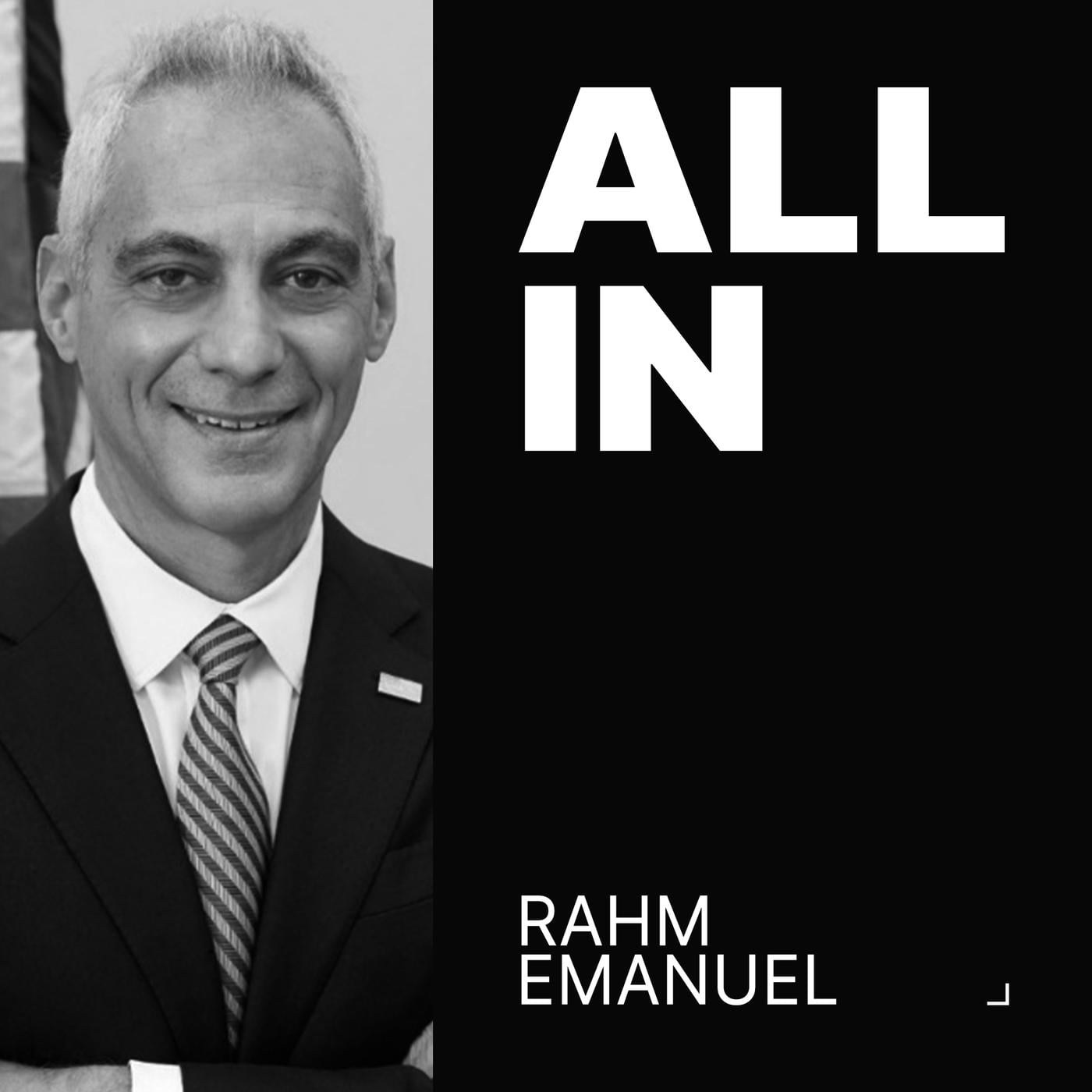
Aug 13, 2026 · 1h 12m
Rahm Emanuel outlines strategy to counter China and reform US immigration
Rahm Emanuel: Trump's Foreign Policy, China, Europe's Decline, Immigration & DSA vs Democrats
As global tensions rise and domestic divisions deepen, understanding the intersection of manufacturing dominance, immigration reform, and effective governance is critical for future stability.
- 1China uses its manufacturing dominance to create global economic dependence as a deliberate geopolitical strategy.
- 2The bipartisan Dignity Act offers a viable path forward for US immigration reform through a merit-based system.
- 3Competent government execution of targeted initiatives is essential to address rising costs and public distrust.
Don't miss
Rahm Emanuel and David Friedberg clash over the long-term economic impacts of government spending on education and housing.
The brief
Veteran political strategist Rahm Emanuel joins the show to dissect the shifting landscape of American foreign policy, economic competitiveness, and the internal ideological battles currently shaping the Democratic Party.
Emanuel argues that China strategically uses its manufacturing dominance to foster global economic dependence, creating a geopolitical leverage point that the United States and its Indo-Pacific allies must actively counter.
Addressing domestic challenges, the discussion shifts to the urgent need for US immigration reform, where Emanuel champions the bipartisan Dignity Act and a merit-based system to retain highly skilled foreign students.
A sharp debate emerges over government spending and rising costs, with Emanuel defending targeted federal initiatives and sharing his direct experiences reforming the Chicago public school system.
Ultimately, Emanuel emphasizes that competent government execution and pragmatic economic growth policies are vital to rebuilding trust and overcoming partisan polarization.
What was said on this episode
37 statements · 14 positive · 18 negative · 5 neutral
China’s largest export is domestic economic dysfunction, not manufactured goods.
“Xi is Largest export is not autos to electronics. It's the domestic economic dysfunction of China.”
Listen at 5:45
The United States is exporting domestic political and cultural dysfunction abroad.
“We are literally exporting both political and cultural dysfunction at our home onto the world.”
Listen at 6:57
The United States and allies should form an economic bloc to withstand China.
“rather than have terrorists, we should have an economic block so all of us together can withstand China”
Listen at 7:29
Trump has damaged the American brand internationally.
“I actually think this president has hurt the American brand.”
Listen at 8:47
America’s military is not prepared for future warfare.
“I happen to think it's not prepared for the future.”
Listen at 9:37
Iran and Ukraine demonstrate that navies are not required to control nearby waterways.
“Neither Iran or Ukraine have a navy and they both control waterways near their fronts.”
Listen at 9:54
China’s strategic objective is global dependence on China and Chinese independence from others.
“China wants everybody dependent on China and them independent of you.”
Listen at 12:56
Cutting NIH funding would undermine American leadership.
“You're not going to cut NIH in your way to American leadership.”
Listen at 15:14
The United States should build a broad economic bloc including Asian, European, and Latin American partners.
“1 aggregate Australia, Japan, South Korea, Taiwan, EU friends in Latin America and get more friends. Don't declare war on Brazil. It's a big economy in the region. Make it an economic block”
Listen at 16:25
U.S. defense technology could produce substantial capabilities within five years.
“You give us five years and our capacity of that incredible system will produce”
Listen at 17:19
U.S. policy opposes changing Taiwan’s status quo through kinetic force.
“as it relates to using kinetic force to change the status quo, we're not ambiguous.”
Listen at 21:12
China is aggressively asserting control in the South China Sea beyond the Taiwan issue.
“I happen to think the South China Sea, everybody talks about the Taiwan. And I'll get to that. I think when you look at the Philippines, Vietnam, Malaysia, and you look at China's behavior and the islands they're creating”
Listen at 24:02
The United States should double military resources supporting the Philippines.
“We need to double them up and give Philippines the confidence”
Listen at 24:51
The United States must prepare for quarantine, invasion, and island-seizure scenarios around Taiwan.
“We have to be prepared for all three.”
Listen at 25:46
U.S. deterrence in the Taiwan region is currently weakened.
“Our deterrence piece is very weakened right now.”
Listen at 26:29
Japan is the most important anchor of U.S. Indo-Pacific policy.
“Japan is the long pole of America's Indo Pacific policy.”
Listen at 26:54
Immigration and economic stagnation both contributed to Europe’s political reaction.
“I think immigration played a role in the same way that I think economic stagnation played a role.”
Listen at 30:09
Strong, technologically capable European economies benefit U.S. security and prosperity.
“It is in our interest for A strong, robust European based economies to be technologically and otherwise contributors to the Western system.”
Listen at 31:28
Merkel’s nuclear shutdown increased Germany’s dependence on Russian energy.
“After the nuclear facility in Japan has its meltdown, she shuts down the nuclear facilities and makes Germany much more dependent on Russian energy.”
Listen at 34:18
European regulation has suppressed innovation, entrepreneurship, and competitiveness.
“Brussels, on the economic front, while they were trying to regulate suffocated innovation, entrepreneurship and competitiveness”
Listen at 35:51
Trump targets weaker leaders while flattering powerful leaders.
“President punches down and kisses up.”
Listen at 36:56
Trump’s foreign policy lacks strategy and is driven by personal insecurity.
“There's no strategy to this. This is all his insecurities.”
Listen at 37:37
The Dignity Act represents a bipartisan compromise balancing enforcement and immigration.
“There's a thing called the Dignity act has 23 Republicans, 23 Democrats in the House. It's true to being a nation of laws and a nation of immigrants.”
Listen at 40:26
Congress should pass the Dignity Act.
“to me, pass the Dignity Act.”
Listen at 41:46
Canada and Denmark offer better immigration models for the United States than Japan.
“I actually think the Canadian model, the Danish model, closer to where we get best practices and lessons learned.”
Listen at 44:02
U.S. universities should be permitted to enroll up to 20% foreign students.
“I would let universities, colleges across the United States go up, set a goal. You can go up to 20% foreign students”
Listen at 44:19
Border control signals that illegal entry will not be rewarded.
“if you control the border, you send a signal that people who break the law don't get rewarded.”
Listen at 45:37
Restrictive zoning and permitting laws drive up housing costs.
“restrictive laws as it relates to zoning, building permitting that drive up costs.”
Listen at 51:21
Private markets alone have failed to solve the first-time homeownership problem.
“the private sector on their own haven't fixed.”
Listen at 52:32
High school graduation should require a documented postsecondary education, military, or vocational plan.
“nobody graduates and gets a high school diploma without showing a letter of acceptance from a college, a community college, a branch of the armed forces or vocational school.”
Listen at 55:46
Education should be aligned with the economy’s workforce and skill requirements.
“Have an education system that actually reflects the economy and skills that we need.”
Listen at 1:02:35
A 10% levy on prediction markets and online sports gaming should fund scientific research.
“4, 10% levy on all predictive markets and online sport gaming and it has to go to the nih, National Science foundation and darpa.”
Listen at 1:04:23
Federal spending should be capped for five years.
“Control the overall spending for the next five years so it can't grow”
Listen at 1:04:46
Funding the Iraq and Afghanistan wars alongside two tax cuts was fiscally misguided.
“We fought Iraq and Afghanistan with two tax cuts never tried in American history and it proved to be stupid.”
Listen at 1:06:43
The minimum wage should rise annually alongside an expanded earned-income tax credit.
“I would raise it and have it go up each year as we did in Chicago, coupled with a very generous earned income tax credit.”
Listen at 1:08:53
The Democratic Socialists of America is a separate party, not part of the Democratic Party.
“You are a separate party. The Democratic Socialist of America. I'll see you in November on the ballot. You had a party convention. You are not a Democrat.”
Listen at 1:10:09
Donald Trump poses an existential crisis, unlike mainstream Democratic leaders.
“I think Donald Trump is an existential crisis.”
Listen at 1:10:37
Statements are attributed to the speaker as said on the episode and reflect their view at the time, not PodLume's. They are not advice.
What people are saying
Rahm Emanuel’s combative All-In appearance left viewers debating substance, style and Friedberg’s restraint
Episode reactions
- Reaction was overwhelmingly negative toward Rahm Emanuel’s combative style, especially repeated clashes with Friedberg and answers viewers felt became speeches.
- Several listeners said Emanuel talked over hosts, dodged questions and made the discussion feel like a political stump speech; some stopped watching early.
- Viewers sharply debated his defenses of Obama-era foreign policy, description of Germany’s politics, and proposed immigration and education solutions.
- A small minority found the interview worthwhile, while one listener wanted deeper discussion of Trump, Israel and Iran policy.
Wider topic conversation
- The broader discussion focused on Emanuel’s argument that China seeks dependence without reciprocal reliance, particularly around trade and Taiwan.
- Commenters disputed his framing of Merkel and Germany, linking immigration policy to Europe’s decline and questioning whether Merkel can be described as conservative.
- The episode also prompted speculation about a possible 2028 Emanuel run and discussion of whether the DSA represents a serious threat or merely a Democratic sideshow.
- Critics revisited the foreign-policy records of the Clinton and Obama administrations, especially Libya, Syria, Ukraine and the broader rise of China.
Featuring
 Rahm Emanuel
 Barack Hussein Obama II
 Iran
IranBooks & mentions
All-In with Chamath, Jason, Sacks & Friedberg
To stay updated on weekly deep dives into technology, geopolitics, and macroeconomics.
Listen to the full episode and explore every guest, topic, and moment on PodLume.