
Sep 23, 2026 · 1h 27m
Investors question AI valuations as models enter a price war
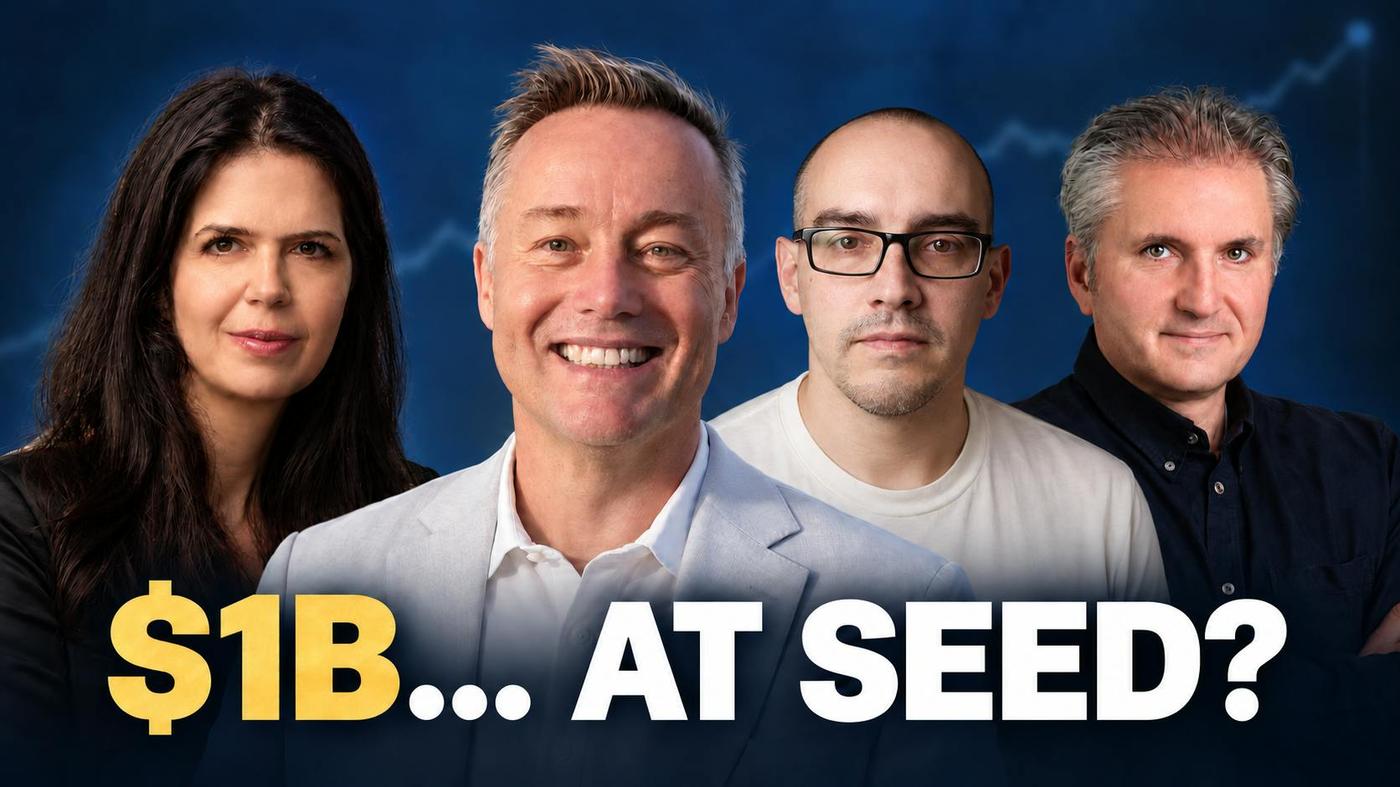
VCs Would Bet on Open-Source AI Over OpenAI and Anthropic | E2341
The panel connects frontier-model economics, inflated private valuations, and tighter venture discipline to the returns founders and investors can realistically expect.
- 1Open-weight models and falling prices challenge whether frontier AI companies can sustain enormous funding requirements.
- 2Instinct’s reported $10 billion valuation tests how much investors will pay before user and revenue evidence arrives.
- 3Higher seed prices and scarce liquidity are forcing founders and funds to balance growth, ownership, terms, and downside risk.
Don't miss
The panel dissects whether Instinct’s reported $10 billion valuation reflects genuine business evidence or the hope of acquisition by a major platform.
The brief
Jason Calacanis convenes Jenny Fielding, Jeff, and Dave for a wide-ranging investor debate on AI risk, startup pricing, liquidity, and the changing economics of venture.
The panel sees AI creating a new entrepreneurial wave, but warns that human judgment may become the weak link when people rely on autonomous systems they cannot effectively supervise.
Instinct’s reported pursuit of a $10 billion valuation becomes a test of venture FOMO: can distribution and acquisition potential justify limited evidence of users or revenue?
OpenAI and Anthropic’s launches and price cuts sharpen the central question: can frontier-model companies become profitable while open-weight competition and routing push margins down?
The discussion widens to rising seed valuations, secondary-market liquidity, and unfashionable fintech and healthcare deals, where disciplined pricing may matter more than market excitement.
The practical conclusion is blunt: founders should weigh valuation, investor quality, and clean terms together, taking attractive capital without over-optimizing in an uncertain market.
What was said on this episode
33 statements · 18 positive · 12 negative · 3 neutral
An AI sovereign wealth fund will be created within six to twelve months.
“there's going to be an AI fund, sovereign wealth fund that'll get cut next year, sometime the next 6 to 12 months”
Listen at 9:21
AI will create a golden age of entrepreneurship.
“I think that this will be kind of the golden age of entrepreneurship”
Listen at 15:46
AI tools expand access to spreadsheet and analytical abilities.
“these tools are just like total unlocks for people that don't know how to use Excel”
Listen at 16:28
AI-enabled humans may cause catastrophic harm even if AI alone does not.
“AI is not going to kill us all, but a human enabled with AI might kill us all”
Listen at 17:44
Cybersecurity will become a massive investment and technology sector.
“I think like cyber is going to be just this massive space”
Listen at 22:54
Major AI companies are innovating at a very high rate.
“the rate of innovation from all the major companies is so high”
Listen at 28:17
AI startups may be displaced by OpenAI, Anthropic, or Meta.
“you don't know whether you're going to be crushed by, you know, whether it's OpenAI or Anthropic or Meta”
Listen at 28:25
Rapid funding does not necessarily indicate a real business or strong business signal.
“a fast funding round with like a real business or a signal around that”
Listen at 28:47
Instinct’s valuation reflects expectations of a major acquisition.
“the valuation for Instinct, I think people are underwriting a major acquisition”
Listen at 29:46
Investing in Instinct at a $10 billion valuation carries long-term risk.
“I would be worried about the long term if I was going in at a $10 billion valuation”
Listen at 33:00
Instinct is consuming substantial cash on compute.
“they're burning so much cash on compute”
Listen at 33:09
Instinct would need at least a $20 billion acquisition to justify its valuation.
“at $10 billion, you have to be purchased for $20 billion at a minimum”
Listen at 35:40
Apple, Amazon, Google, and Microsoft are potential Instinct acquirers.
“the acquirers are substantial, like Apple, Amazon, Google, Microsoft are all potential acquirers”
Listen at 37:21
Apple and Amazon currently lack agent products and need them.
“Apple and Amazon are definitely, you know, they have to have an agent product and they don't right now”
Listen at 38:05
Frontier-model token pricing is undergoing a race to the bottom.
“it's a race to the bottom”
Listen at 44:24
Falling AI model costs lower barriers to entry for competitors.
“your barrier to entry, other barrier to entry goes down as the costs come down as well”
Listen at 45:51
AI model usage will shift entirely toward open-source models.
“we're gonna go all open source”
Listen at 48:08
Open-weight models already account for most token usage.
“open weight models have taken over majority of token usage”
Listen at 49:29
OpenAI and Anthropic will continue performing well.
“both OpenAI and Anthropic are going to do fine”
Listen at 50:37
OpenAI and Anthropic will both become publicly traded companies.
“They're both going to go public”
Listen at 50:40
Anthropic may reach at least $2–2.5 trillion and OpenAI about $1.5 trillion in valuation.
“my guess is Anthropic at least $2, $2.5 trillion, and probably OpenAI $1.5 trillion”
Listen at 50:42
Investors should not currently buy OpenAI or Anthropic public-market shares.
“I would not advise people to buy right now”
Listen at 52:32
SpaceX is currently too expensive for Jeff to buy.
“I'm still looking for my entry Entry price in SpaceX. So I haven't bought SpaceX. I want to own SpaceX, but it's too expensive right now”
Listen at 53:14
A $5–6 million Uncork investment may require a 30x return.
“we need to make a 30x”
Listen at 56:33
Top private-company names currently have seller-favorable secondary markets.
“there are assets, uh, again, the top 30 names, it's a seller's market for those assets”
Listen at 58:21
Private companies outside the top 30 may lack secondary-market demand.
“If you go outside the top 30 names, there's not necessarily a market for the names”
Listen at 58:40
Greater private-company transparency would lower cost of capital.
“cost of capital would be lower if they were more transparent”
Listen at 59:30
Comparable private companies would historically have gone public at $50–100 million revenue.
“all these companies would have gone public 10 years ago at $50 to $100 million in revenue”
Listen at 1:00:19
Jeff’s portfolio has experienced more acquisitions recently.
“We've seen, you know, more acquisitions”
Listen at 1:06:35
The fintech-healthcare startup should have raised its Series A earlier.
“The lesson is timing. They should have raised 18 months ago”
Listen at 1:13:49
Founders should accept available financing in the current environment.
“if someone wants to give you money, take it”
Listen at 1:14:10
Loft Orbital announced a $1 billion Abu Dhabi investment.
“Loft Orbital, which just announced a billion-dollar investment from Abu Dhabi”
Listen at 1:19:39
Post-money round prices can serve as objective SPV transfer prices within three to six months.
“within 3 to 6 months, you can use the post-money price on that round as a legitimate objective transfer price”
Listen at 1:22:13
Statements are attributed to the speaker as said on the episode and reflect their view at the time, not PodLume's. They are not advice.
Featuring
 Jenny Fielding
 Techstars
 Claude
 Amazon.com, Inc.
 Jen-Hsun Huang
Listen to the full episode and explore every guest, topic, and moment on PodLume.