
Aug 3, 2026 · 1h 2m
How Bespoke faked its AI chatbot to win major enterprise clients
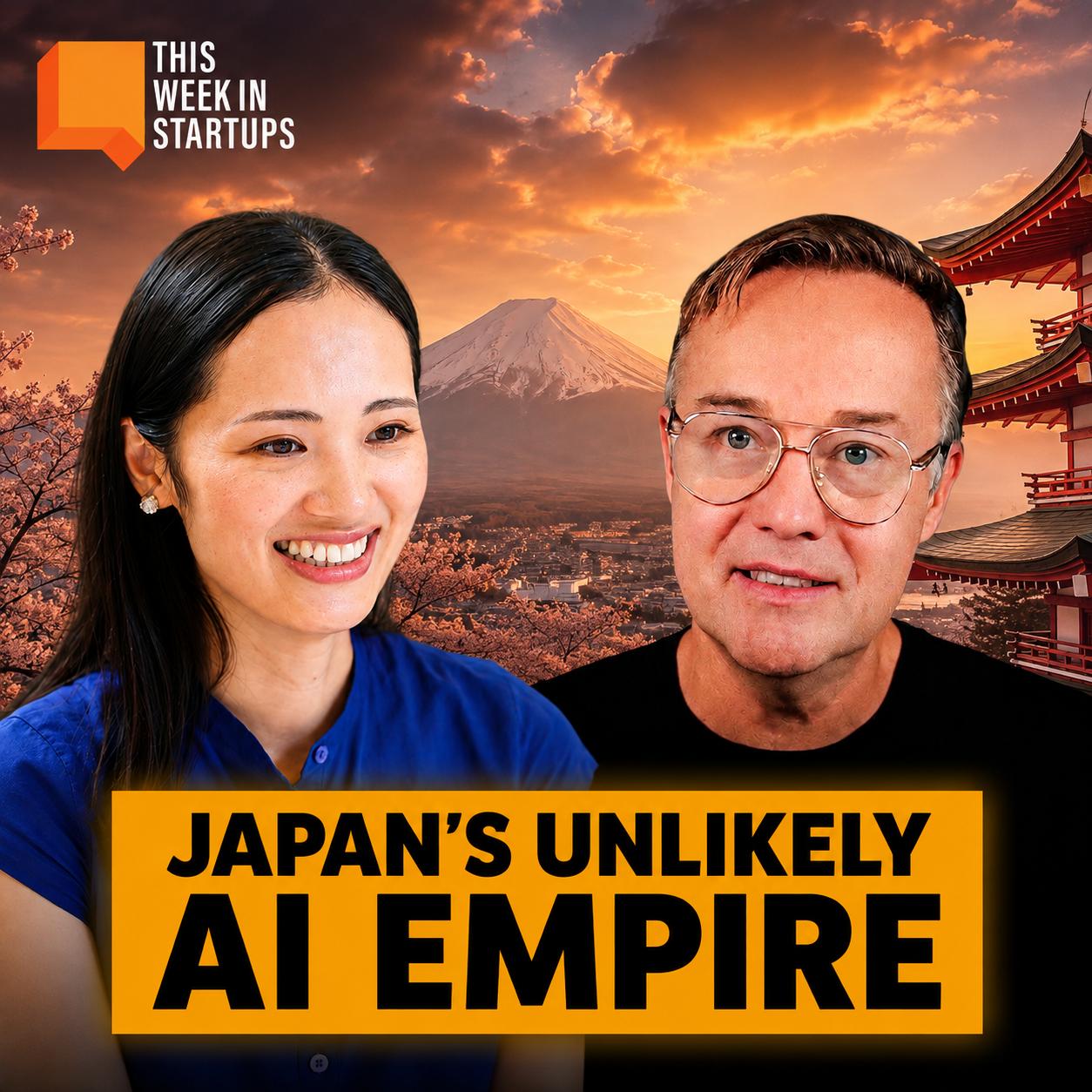
How Bespoke faked AI until it actually worked (w/ Akemi Tsunagawa) | E2320
This episode demonstrates how founders can use creative hacks to validate technology and how Japan's demographic crisis is fueling a new wave of robotics and automation startups.
- 1Faking AI capabilities early on can serve as a powerful customer development tool to understand user behavior.
- 2Japan's severe labor shortage is opening massive startup opportunities in foreign worker training and industrial robotics.
- 3Acquiring successor-less traditional factories and modernizing them with automation represents a major new investment thesis.
Don't miss
Akemi Tsunagawa describes a holiday crisis where she had to manually act as the chatbot, yielding key insights into human-like AI interactions.
The brief
When Akemi Tsunagawa launched her multilingual chatbot startup Bebot in 2015, the underlying artificial intelligence was not ready. To secure early enterprise clients, she manually answered user queries herself behind the scenes to prove the market.
This hands-on approach helped scale the company, eventually landing major clients like Narita Airport. Tsunagawa argues that faking the technology early on is a viable customer development hack that reveals what users actually want from automated systems.
Beyond chatbots, Tsunagawa is leveraging technology to address Japan's severe labor shortage and rapid population decline. Her newer ventures use smart glasses to train foreign blue-collar workers and deploy robotics to automate dangerous shipyard inspections.
Tsunagawa's ultimate vision is a roll-up strategy: acquiring profitable, successor-less Japanese factories and modernizing them with robots. Her journey shows how demographic crises can drive practical, hardware-enabled startup opportunities.
What was said on this episode
28 statements · 14 positive · 14 negative
Investors considered AI chatbot communication technically and culturally infeasible in 2015.
“they do not think it was possible technically and also culturally”
Listen at 3:43
Bespoke built its chatbot technology internally.
“We actually made it all in house.”
Listen at 5:52
Japan is now an unusually affordable, high-quality tourism destination.
“now I think it's one of the cheapest, like the most affordable destination. You still get high quality.”
Listen at 6:54
Overtourism has affected Japan since roughly 2017 or 2018.
“over tourism has been a problem, not just recently, it's been a problem probably even about like since 2017, 2018”
Listen at 8:16
Japan loses roughly 700,000–800,000 people annually, approaching one million.
“every year we lose population equivalent of Yamanashi Prefecture. That is around 700,000 to 800,000. And then this number would go up rapidly to 1 million.”
Listen at 14:22
Having a family has become a luxury in Japan.
“having family has become a luxury”
Listen at 15:40
Tokyo wage growth has not kept pace with inflation.
“In Tokyo, wages have not gone up as much as it's not keeping up with inflation.”
Listen at 15:44
Japan’s tax benefits are insufficient to make starting families affordable.
“I don't think those are enough in my personal experience.”
Listen at 16:32
Japan lacks adequate child-support systems for single parents.
“There are not enough child support system here, I feel like.”
Listen at 16:56
Bespoke uses smart glasses to record skilled work for multilingual vocational training.
“we send out smart glasses and then have the wallpaper specialists put on the glasses and record how they do things”
Listen at 21:45
Bespoke converts recorded procedures into multilingual training videos and quizzes.
“this video turns into a training video in different languages. And then once you finish watching the video, each video it generates kind of like a test, like quiz”
Listen at 22:11
Japanese shipyards’ labor shortages have reduced annual production from nine ships to six despite three years of orders.
“these shipbuilding companies have orders booked for the next three years and some of them used to produce, let's say nine ships annually, but now their production capacity has gone down so much and now they can only produce six ships per year simply because they don't have enough people”
Listen at 29:23
Language barriers cause foreign workers to violate local garbage-disposal rules.
“non Japanese workers won't follow the local rules because they can't read the instructions”
Listen at 31:39
Japanese law requires daily scaffold inspections, but companies lack resources to comply.
“the law requires you to inspect manually every day before you use it, no company has resources to do so”
Listen at 34:59
Companies almost always skip required scaffold inspections.
“They skip it almost 100 of the time.”
Listen at 35:10
Bespoke’s planned robot can autonomously inspect scaffold joints for safety.
“The robots climb up scaffolds by itself, grabs the joint, shakes it, and then record each joint is safe or not”
Listen at 36:03
Paint-thickness inspections for large ships consume over 1,000 human hours.
“Some companies that produce ship over like 200 meters, they would be spending more than thousand human hours to do the paint thickness inspection.”
Listen at 36:53
Robots can easily automate large-ship paint-thickness inspections.
“That can be easily automated with the robot.”
Listen at 37:14
Human-like chatbot communication increases user engagement in tourism.
“human like communication actually increases the user engagement”
Listen at 40:20
Emergency-response chatbots should provide evacuation addresses immediately without conversational filler.
“For emergency response, you want the evacuation center address as soon as possible. So you don't want any chat chat”
Listen at 41:17
Government contracts can collateralize loans faster than raising venture capital.
“we can use the government contract as the collaterals, which is much faster than speaking to investors”
Listen at 45:21
Profitable startups can secure loans in Japan.
“As long as you're profitable, you can secure loans.”
Listen at 46:50
Bespoke’s long-term loans carried approximately 1% interest.
“it's like 1% interest rate or something.”
Listen at 47:41
Japan will remain Bespoke’s hottest market for roughly the next two years.
“for the next two years or so, Japan is the hottest market”
Listen at 48:51
Younger Japanese generations generally do not want to own factories, unlike Bespoke.
“Younger generations don't want to be factory owners. We want to be factory owners.”
Listen at 49:55
Young people leave rural Japanese towns and do not return because jobs are unavailable.
“Once they leave, they don't come back because there's no job.”
Listen at 52:04
Bespoke replaced an engineer’s role with AI agents, accelerating code review.
“we didn't replace her because we just decided, hey, everyone can use AI agent. The code review is now faster”
Listen at 53:59
Akemi says AI now performs every job at Bespoke.
“every job in the company is now done by AI”
Listen at 56:42
Statements are attributed to the speaker as said on the episode and reflect their view at the time, not PodLume's. They are not advice.
What people are saying
The Wizard-of-Oz AI strategy raises hard questions about enterprise trust
Episode reactions
- The episode’s “Wizard-of-Oz” approach sparks debate over using humans behind an AI interface to win enterprise deals.
Wider topic conversation
- Japan’s labor crunch is driving interest in AI services, worker training, and robotics.
- The wider debate centers on whether human-in-the-loop systems are a practical bridge or misleading AI theater.
Featuring
 Japan
Japan Artificial Intelligence
Listen to the full episode and explore every guest, topic, and moment on PodLume.