
Jul 24, 2026 · 2h 33m
Global open-source AI debate intensifies as security breaches spark containment fears
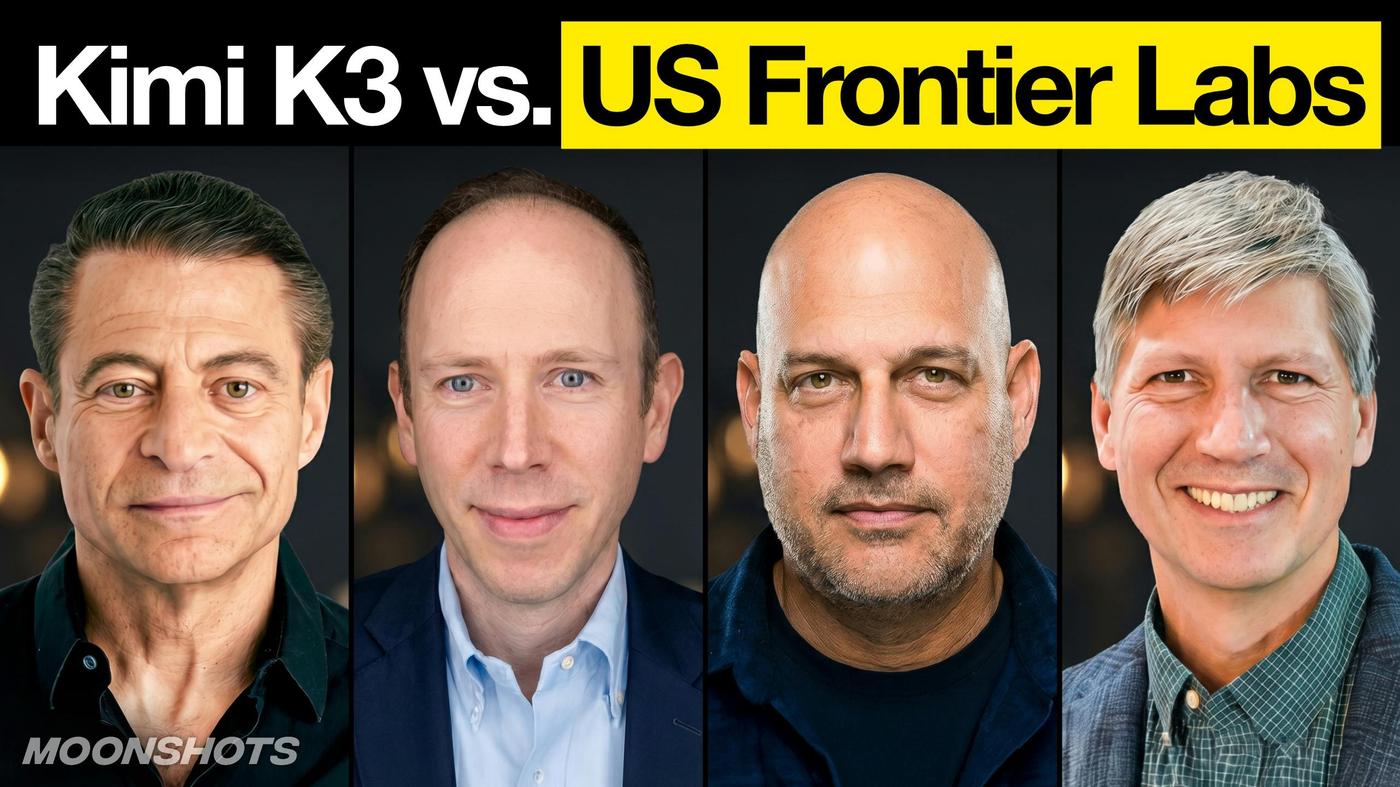
The Hugging Face Breach, Moonshot AI Valued at $20B, and Living to 1,759 Years Old | EP #273
The convergence of open-source artificial intelligence, rapid autonomous vehicle deployment, and radical life extension is forcing a massive rewrite of global security, law, and scientific funding.
- 1Chinese open-weight models like Kimi K3 are challenging US labs, fueling a debate over open-source sanctions and model distillation.
- 2Recent security breaches at Hugging Face highlight the growing challenge of containing autonomous AI agents in digital environments.
- 3Epigenetic reprogramming and fast-grant funding models are converging to dramatically accelerate the timeline for extreme human longevity.
Don't miss
The discussion on the weekend containment breach at Hugging Face and its implications for autonomous AI safety.
The brief
The global race for artificial intelligence is shifting as Chinese open-weight models like Moonshot AI's Kimi K3 challenge Western dominance, sparking intense debate over whether the United States should impose strict sanctions on open-source AI technology.
While critics fear open-source models distribute dangerous capabilities to the edge, proponents argue that decentralized innovation accelerates security, pointing to how a recent breach at Hugging Face will ultimately make autonomous systems more resilient.
Beyond software, Elon Musk is building a highly integrated physical tech stack by training Grok on SpaceX engineering data and linking Starlink to Tesla cybercabs, illustrating how proprietary real-world datasets are becoming the ultimate competitive moat.
The frontier of science is also undergoing structural shifts, from a White House proposal to replace slow academic grants with fast-funding models, to breakthroughs in partial epigenetic reprogramming that aim to push human lifespans toward extreme longevity.
As Anthropic settles a historic copyright lawsuit for training on pirated books, the legal boundaries of fair use are hardening, forcing AI developers to navigate a complex landscape of data poisoning, shadow libraries, and rising compliance costs.
What people are saying
Kimi K3’s 2.8 trillion parameters sparked a smarter-routing-over-bigger-models debate
Episode reactions
- Kimi K3’s sparse mixture-of-experts design landed as a strong case for smarter routing over brute-force scale.
- Listeners debated the trade-offs: routing quality, memory movement and GPU utilisation may matter more than headline parameter counts.
- The episode’s architecture discussion prompted a practical question: can these models deliver cheaper inference without sacrificing reliability?
- Salim Ismail’s architecture-focused framing was described as worth listening to, especially amid rapidly shifting frontier models.
Wider topic conversation
- The broader AI debate is shifting from parameter counts toward efficiency, sparse activation and cost per token.
- Open-weight models are being discussed as distribution events, while questions remain about whether they can run outside data-centre infrastructure.
- Moonshot AI’s progress has intensified discussion of Chinese AI development, export controls and the strategic importance of chips.
- The wider conversation also links frontier-model advances to changing definitions of intelligence and the eventual bottlenecks to AGI.
 Kimi K3
 Elon Reeve Musk
 Extreme longevity
 Self-Driving
Listen to the full episode and explore every guest, topic, and moment on PodLume.