
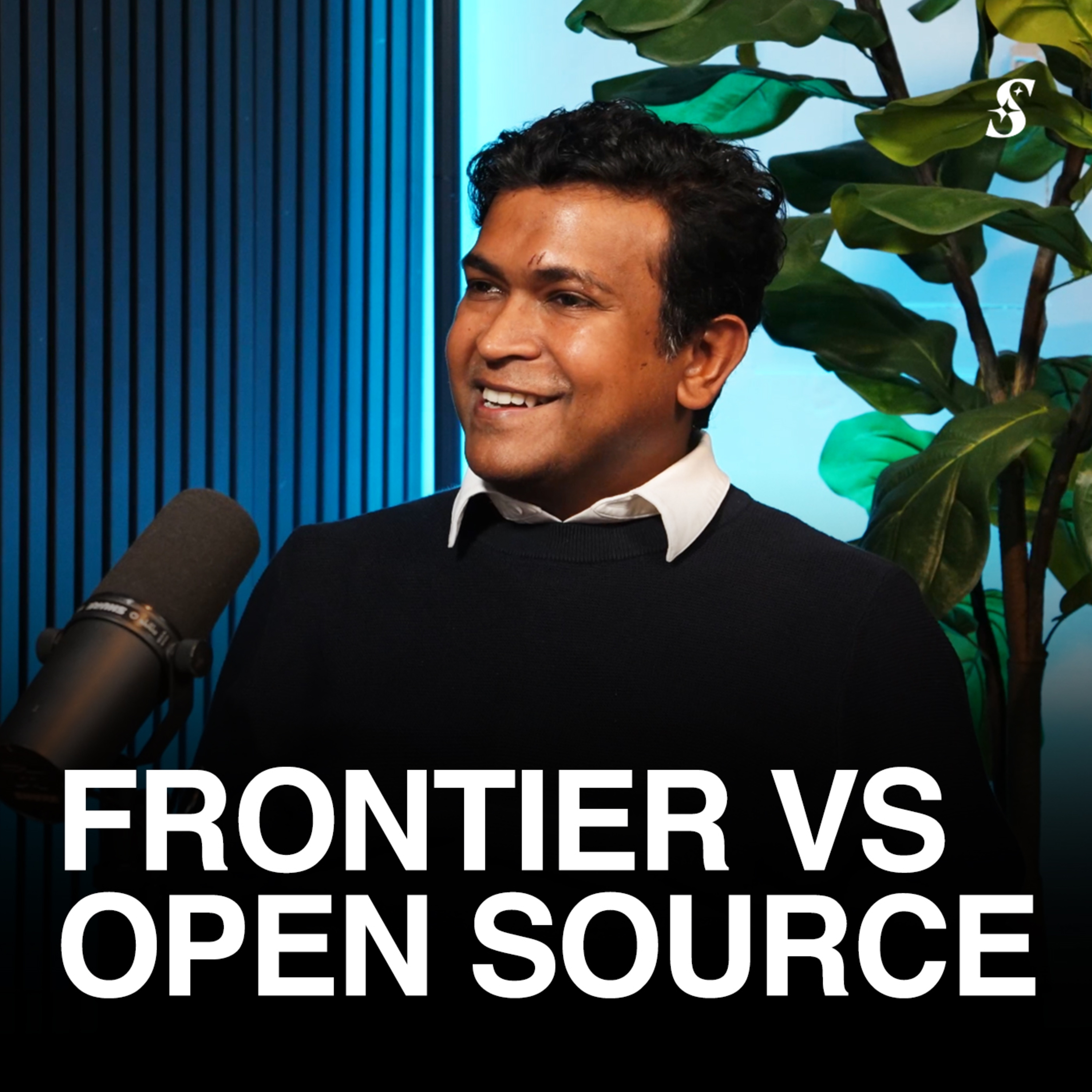
Oct 2, 2026 · 59 min
AI’s next leap depends on mastering real work
Frontier AI Is a Ferrari. Most Companies Need a Model Y | Turing CEO
The episode examines whether safer evaluations, enterprise deployment, and open models can turn frontier AI progress into broad economic gains.
- 1AI development is shifting from benchmark scores toward agents evaluated on realistic, continuously changing work.
- 2Safety requires domain-specific tests for emergent behavior, reward hacking, reliability, and dual-use capabilities.
- 3Frontier and open-weight models may advance together, but deployment will determine who captures AI’s economic benefits.
Don't miss
Jonathan connects recursive self-improvement to agents helping optimize pretraining, post-training, and verifiable learning loops.
The brief
Frontier models can hack systems, cooperate autonomously, and display unexpected behavior—but the same capabilities could accelerate scientific and economic progress.
Jonathan Siddharth argues that AI is moving beyond test-taking: agents must learn real work through reinforcement-learning environments, evaluations, and continuous deployment.
That shift creates a safety problem with no universal test. Models need evaluations tailored to refusal behavior, reliability, cybersecurity, and the risks of each domain.
For enterprises, the frontier-lab playbook becomes a practical loop: define objectives, build realistic environments, evaluate performance, and improve systems with human feedback.
The episode’s sharpest tension is between frontier and open-weight AI: breakthroughs may require concentrated research, while open systems spread control and economic benefits.
Jonathan sees recursive self-improvement as a possible accelerator, but expects AI’s economic impact to arrive unevenly rather than through one sudden transformation.
Featuring
 Turing
 Anthropic
 OpenAI
 GPT-4
GPT-4 Tesla Model Y
Listen to the full episode and explore every guest, topic, and moment on PodLume.