
Oct 5, 2026 · 33 min
AI policies fail without accountable governance
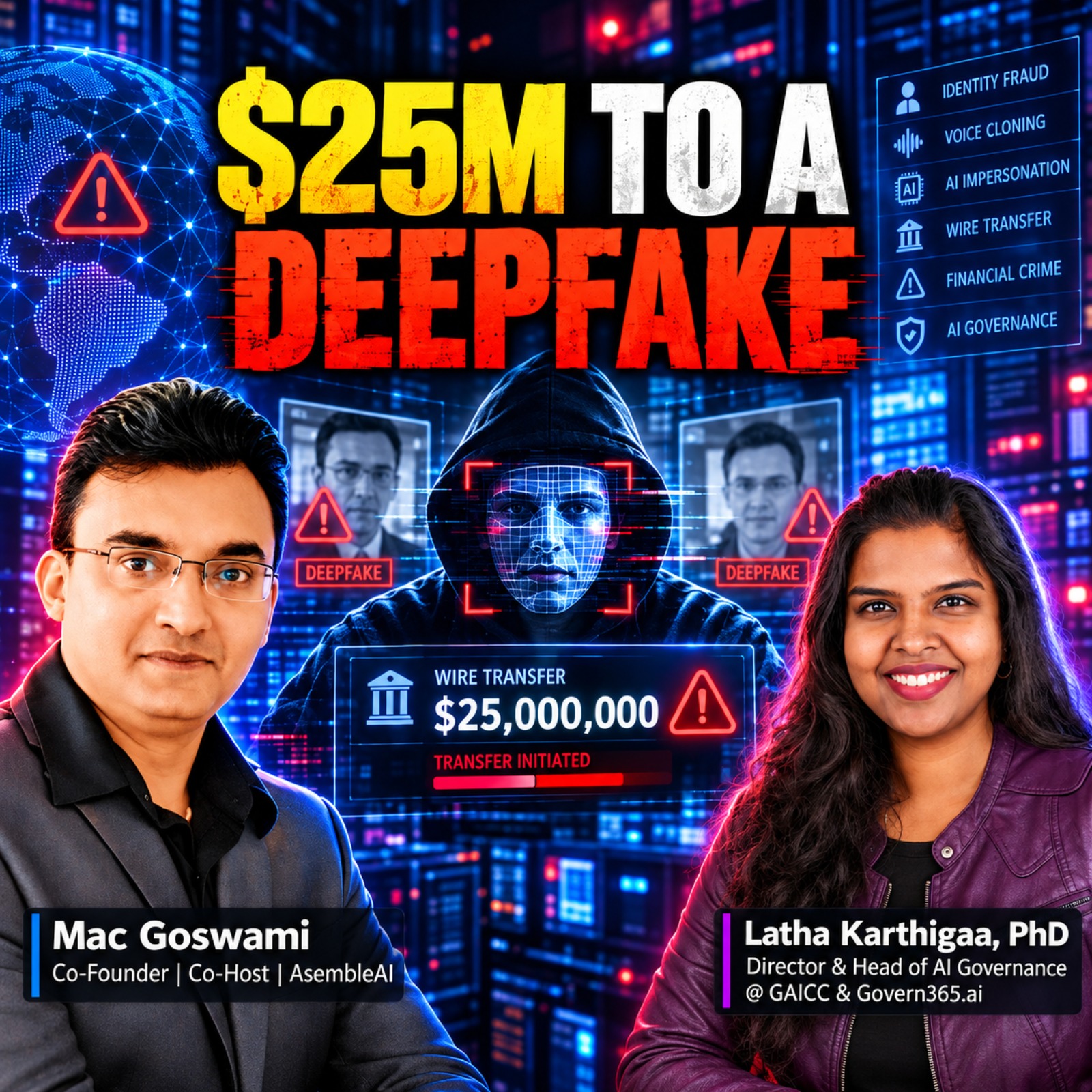
They Transferred $25M to a Deepfake — Why Your AI Isn't as Governed as You Think | Dr. Latha Karthigaa
As AI enters healthcare, employment, education, and safety, organizations need systems that assign responsibility and manage real-world risks beyond compliance paperwork.
- 1AI governance combines evolving controls, employee training, cross-functional expertise, empathy, and named human accountability.
- 2Healthcare bias, algorithmic government failures, and deepfake fraud show how unmanaged AI can produce serious human and financial harm.
- 3ISO/IEC 42001 offers a certifiable management system, but smaller organizations can begin with policies and established risk frameworks.
Don't miss
Latha identifies unclear accountability as a central governance failure and insists that every AI use case have a named person responsible for it.
The brief
Dr. Latha Karthigaa argues that organizations rush into AI with policies but without the rules, controls, training, and ownership needed to govern its consequences.
The episode connects unmanaged AI to deepfake fraud, biased healthcare systems, and algorithmic government failures, showing why governance is more than dataset management or checklist compliance.
Karthigaa frames governance professionals as translators between legal, engineering, and development teams who must pair technical fluency with empathy for affected people.
ISO/IEC 42001 can demonstrate a structured management system, but smaller organizations may start with an AI policy or established frameworks before pursuing costly certification.
The sharpest prescription is simple: every AI use case needs a named human owner, because the organization deploying a tool remains responsible for its use.
Featuring
 ChatGPT
 United States
 European Union
Listen to the full episode and explore every guest, topic, and moment on PodLume.