
Sep 30, 2026 · 18 min
A Fresh Lunar Crater Opens a Window on Alien Technology
Examining a new lunar crater + searching for signs of alien technology
The episode connects close study of lunar impacts with a broader question: what durable evidence could reveal intelligent life beyond Earth.
- 1Before-and-after Lunar Reconnaissance Orbiter images identified a crater formed on the Moon in spring 2024.
- 2Impact ejecta and thermal changes help scientists interpret lunar soil and understand planetary surface processes.
- 3Technosignature searches range from radio signals and lasers to city lights, pollution, and debris preserved in lunar dust.
Don't miss
Sofia Z. Sheikh explains why lunar dust could preserve alien technological debris, while emphasizing the enormous infrastructure required to make that evidence detectable.
The brief
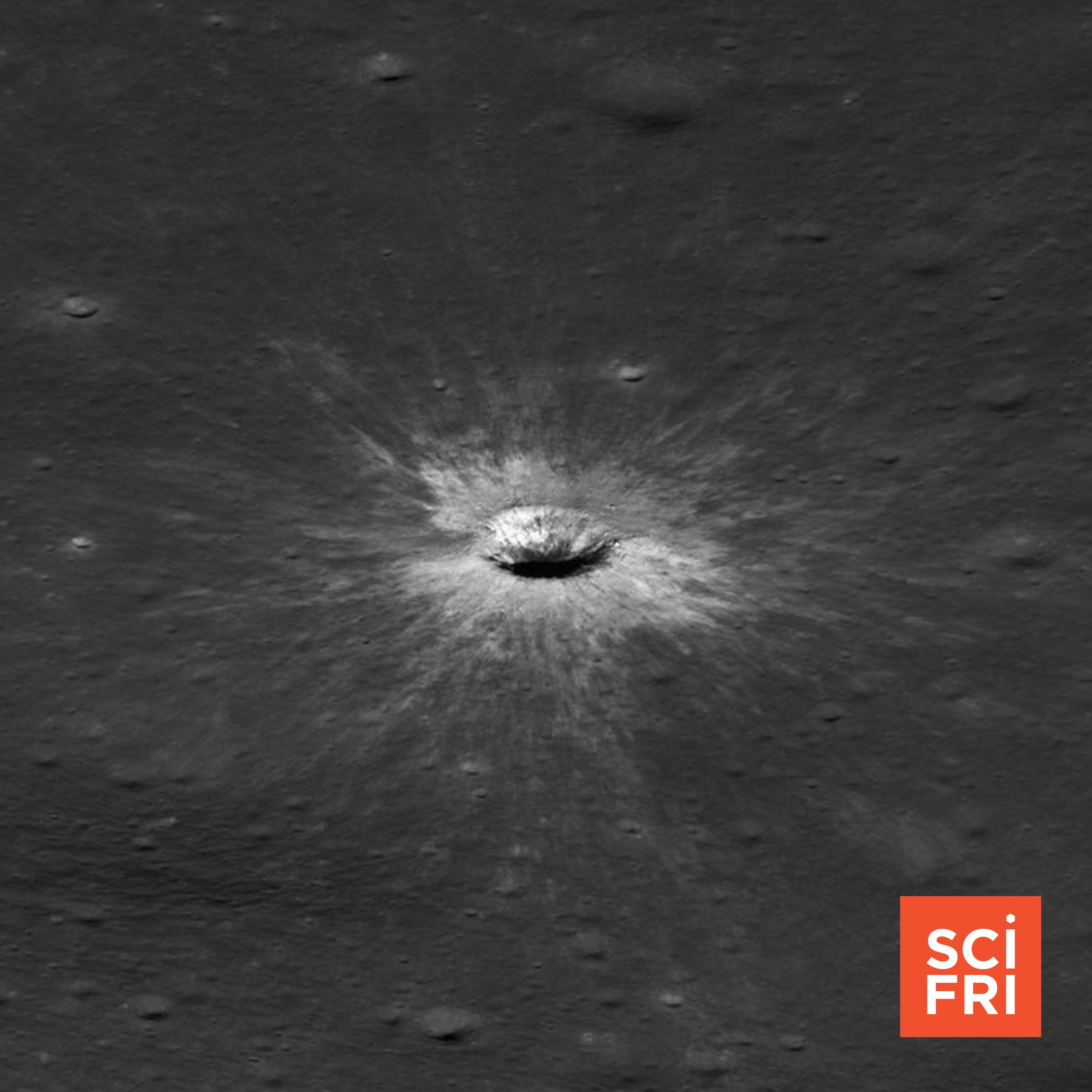
A crater formed sometime in spring 2024 gives scientists a rare natural experiment: Tyler Powell explains how before-and-after Lunar Reconnaissance Orbiter images revealed the impact and its aftermath.
Powell shows why the crater matters beyond its size. Ejecta reshape the Moon’s surface and alter lunar soil’s thermal behavior, offering clues for planetary geology and regolith interpretation.
Sofia Z. Sheikh turns the Moon into a possible archive for technosignatures, arguing that technological debris could persist in lunar dust—but finding it would require enormous alien infrastructure.
The search then expands from radio waves, favored for their low energy demands and reach through galactic gas and dust, to lasers, city lights, and atmospheric pollution.
The episode’s central shift is from detecting signals to reading remnants: technosignature science combines astronomy, archaeology, and speculation about what civilizations leave behind.
Featuring
 Tyler Powell
 Sofia Z. Sheikh
 Lunar Reconnaissance Orbiter
 SETI Institute
 Dyson sphere
Listen to the full episode and explore every guest, topic, and moment on PodLume.